Roulette Wheel Layout, Numbers and Table Map
A European roulette wheel has 37 pockets: 0 and 1–36. An American wheel has 38: 0, 00 and 1–36. Their clockwise number orders differ; the betting table arranges 1–36 in twelve rows of three.
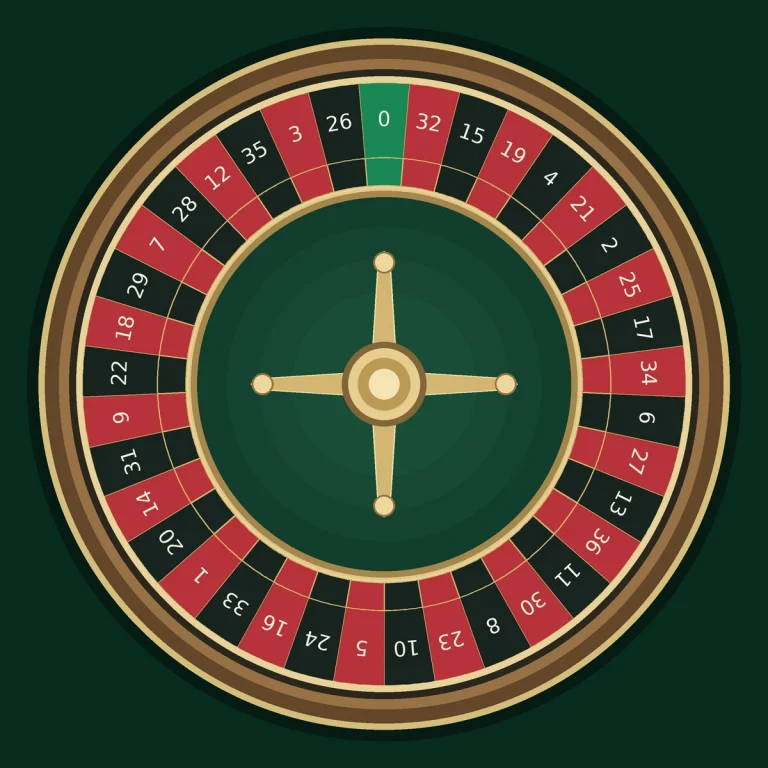
Interactive roulette wheel numbers map
Select a pocket from the wheel, table or dropdown. The map identifies its clockwise position, immediate wheel neighbors and every standard outside group that contains it.
European wheel order
Clockwise from 0 at the top. White marks the selected pocket; gold marks its neighbors. Use the dropdown for a larger selection control, or the arrow keys when a wheel pocket has focus.
European table layout
Number grid, shown vertically. The zero area is schematic; chip-placement lines vary by table.
1, 4 … 34 Column 2
2, 5 … 35 Column 3
3, 6 … 36
Five-pocket wheel band centred on 0
Standard table groups containing this pocket
Highlighted labels identify groups containing the selected number. This key does not show where to place chips.
Zero belongs to the green zero area. It is not part of a dozen, column, red/black, odd/even or low/high wager.
How many numbers are on a roulette wheel?
A standard European roulette wheel has 37 pockets: one green 0 plus numbers 1–36. A standard American roulette wheel has 38 pockets: green 0 and 00 plus numbers 1–36. Both standard wheels keep eighteen red and eighteen black numbered pockets.
The numbered pockets are not arranged in numerical order, and the European and American sequences are different. A triple-zero roulette wheel adds a third green result for 39 pockets, so it belongs to a separate wheel and probability model rather than the standard 37- or 38-pocket layouts below.
What do roulette numbers add up to?
The numbers 1 through 36 add up to 666. Adding 0 does not change that total, and 00 is also a zero-value label, so the numbered total remains 666 on standard European and American wheels. This is arithmetic trivia only; the sum has no effect on roulette odds, payouts or wheel behavior.
European roulette wheel numbers
A standard European wheel has 37 equally spaced pockets. Zero is green, while 1–36 contain eighteen red and eighteen black pockets. The official sequence below runs clockwise from 0. For probability, payout and expected-loss calculations on this format, use the European roulette calculator.
0 · 32 · 15 · 19 · 4 · 21 · 2 · 25 · 17 · 34 · 6 · 27 · 13 · 36 · 11 · 30 · 8 · 23 · 10 · 5 · 24 · 16 · 33 · 1 · 20 · 14 · 31 · 9 · 22 · 18 · 29 · 7 · 28 · 12 · 35 · 3 · 26Zero sits between 26 and 32. The sequence spreads consecutive table numbers around the wheel. For example, 1 is next to 33 and 20 on the European wheel, not beside 2 as it is on the betting grid.
American roulette wheel order
A standard American wheel has 38 pockets because it adds 00. The 0 and 00 pockets are green and sit opposite each other in the standard sequence, while the 1–36 color assignments remain unchanged. The American roulette calculator applies this 38-pocket model to standard bets and the first-five exception.
0 · 28 · 9 · 26 · 30 · 11 · 7 · 20 · 32 · 17 · 5 · 22 · 34 · 15 · 3 · 24 · 36 · 13 · 1 · 00 · 27 · 10 · 25 · 29 · 12 · 8 · 19 · 31 · 18 · 6 · 21 · 33 · 16 · 4 · 23 · 35 · 14 · 2On this wheel, 0 sits between 2 and 28, and 00 sits between 1 and 27. The American order is not the European sequence with 00 inserted. Most numbered pockets have different wheel neighbors, so sector and neighbor calculations must use the selected model.
How the roulette table layout works
A standard roulette table shows the green zero area beside a numbered betting grid. The grid places 1–36 into twelve rows of three numbers. In the upright diagram above, read the columns downward: column 1 is 1, 4, 7 … 34; column 2 is 2, 5, 8 … 35; column 3 is 3, 6, 9 … 36. The outside-bet areas group the same numbers into dozens, columns, colors, parity and low/high ranges.
Inside wagers use the numbered boxes, dividing lines and intersections. A live table or app may rotate this grid, but the numbers in each column remain the same. A chip position determines coverage; the wheel order does not change where an inside wager is placed. The roulette bet-placement guide maps those chip positions to straight, split, street, corner, six-line and outside wagers.
| Layout group | Numbers | What zero does |
|---|---|---|
| First dozen | 1–12 | Green pockets excluded |
| Second dozen | 13–24 | Green pockets excluded |
| Third dozen | 25–36 | Green pockets excluded |
| Column 1 | 1, 4, 7 … 34 | Green pockets excluded |
| Column 2 | 2, 5, 8 … 35 | Green pockets excluded |
| Column 3 | 3, 6, 9 … 36 | Green pockets excluded |
| Even-money groups | 18 red or black, odd or even, low or high numbers | Green pockets are excluded under standard coverage |
Roulette number colors
The red numbers are 1, 3, 5, 7, 9, 12, 14, 16, 18, 19, 21, 23, 25, 27, 30, 32, 34 and 36. The black numbers are 2, 4, 6, 8, 10, 11, 13, 15, 17, 20, 22, 24, 26, 28, 29, 31, 33 and 35. Zero and double zero are green.
Red and black numbered pockets alternate around both standard wheels, interrupted by the green pocket or pockets. Color does not mean odd or even: 11 is black and 12 is red.
Wheel neighbors versus table neighbors
Wheel neighbors are the pockets immediately before and after a number in the circular sequence. Table neighbors are boxes that share a line or corner on the rectangular betting grid. For example, 1 shares grid edges with 2 and 4, but its European wheel neighbors are 33 and 20.
A split bet depends on table adjacency. A neighbor or racetrack selection depends on physical wheel adjacency. For example, 17 and 20 share a grid edge and can form a split. Numbers 18 and 19 are consecutive in value but sit at opposite ends of different rows, so they do not form a standard split.
Try number 17 on both wheels
The band follows clockwise wheel order, not numerical order. The roulette call-bets calculator calculates stakes and returns for European neighbor bands and the Voisins, Tiers, Orphelins and Jeu Zéro packages.
When a double-zero wheel is used as single-zero
Pennsylvania rules allow a physical double-zero wheel and layout to operate as a single-zero game when the 00 wagering area is covered by an approved device and the table displays clear notice that 00 is unavailable.
If the ball lands in 00 under that configuration, the spin is declared void and the wheel is respun. Standard red, black, odd, even, 1–18 and 19–36 wagers still lose when the available green 0 lands.
This is why the physical number of pockets and the active table rules should be checked separately: a 38-pocket wheel can be governed by a 37-outcome betting procedure.
When comparing roulette game formats available in casino lobbies, identify the specific table and read its rules. A wheel image alone does not establish how zero outcomes are settled.
Why the wheel order matters
The roulette wheel numbers sequence is required for identifying physical sectors, checking neighboring pockets and understanding racetrack-style selections. It is also relevant when recorded outcomes are grouped by wheel area rather than by numerical value.
In the map, wheel position counts clockwise from 0 as position 1. Steps from 0 is the shorter route around the circle in either direction. European 26 is therefore position 37, but only one step from 0. Neither figure measures how soon a number is likely to land.
The order does not change the one-spin probability of an individual pocket on a fair wheel. Each pocket still represents one possible result out of 37 or 38.
What the layout does not show
The numerical 1–36 grid does not reproduce the wheel order. A separate racetrack diagram may appear alongside it. The table does not display the circular distance between pockets, whether two numbers are opposite each other, or whether they belong to the same physical sector.
Conversely, the wheel does not show chip-placement intersections, dozens or columns. Both views are needed to understand placement and physical order without confusing them.
Roulette rules and wheel behavior
The number map identifies physical order and table position. Use the specialised page for bet placement, racetrack sectors, standard wheel mathematics or non-standard green-pocket layouts.
Common questions about roulette wheel numbers
How many numbers are on a roulette wheel?
There are 37 pockets on a standard European wheel: 0 and 1–36. A standard American wheel has 38 pockets because it adds 00.
Are the wheel numbers in numerical order?
No. The circular order is non-numerical and differs between standard European and American wheels. The betting table, by contrast, arranges 1–36 in numerical rows.
Are 0 and 00 next to each other?
Not on the standard American sequence shown here. They are placed opposite each other, with nineteen steps in either direction on the 38-pocket wheel.
Is zero an even number in roulette?
Mathematically, zero is even, but a roulette even bet covers only 2, 4, 6 … 36. Neither 0 nor 00 belongs to the odd/even, low/high, red/black, dozen or column groups.
Which numbers are red in roulette?
The red pockets are 1, 3, 5, 7, 9, 12, 14, 16, 18, 19, 21, 23, 25, 27, 30, 32, 34 and 36.
What are five roulette wheel neighbors?
A five-pocket band consists of the selected number plus two pockets on each side. Around European 0, it is 3, 26, 0, 32 and 15. The selected number is included in the five; this is different from Voisins du Zéro, which covers 17 pockets.
Primary sources for wheel order and layout
Was this tool helpful?
What went wrong?
For calculation problems, inputs and results are attached to your report.