Labouchere Roulette Calculator
The cancellation system turns a profit target into a line of positive numbers. Each wager uses the two outside values, a win removes them, and a loss adds the wager to the end. This calculator preserves the exact line after every result and stops before an unaffordable or over-limit bet.
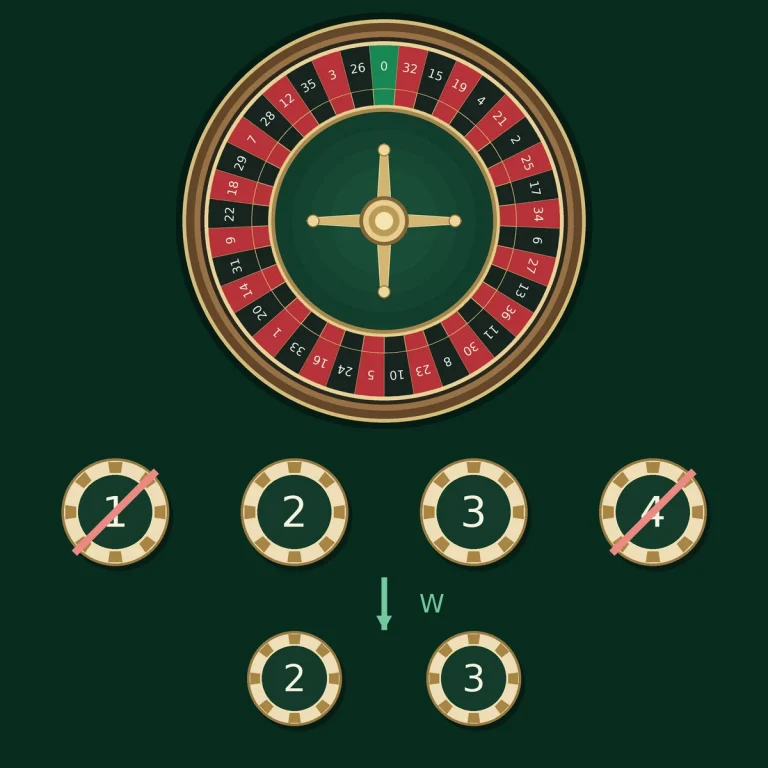
What is the Labouchere system in roulette?
Labouchère, also called the cancellation system or split Martingale, turns a target into a line of positive numbers. The next even-money wager is the first value plus the last value; after a win those outside values are removed, and after a full loss the wager value is appended to the end of the line.
The sequence can organize stake sizes and target accounting, but it does not change the probability of the next roulette result. The roulette strategy and bankroll-risk guide compares Labouchère with other progression systems and flat betting without treating any staking rule as a way to remove the house edge.
Does the Labouchere system work?
It works as a defined cancellation method: if the line is eventually emptied under the stated 1:1 settlement rules, the cycle finishes at the original line-sum target. Completion is not guaranteed. Losses can lengthen the line and enlarge later bets until bankroll or table limits prevent the next required wager.
Calculate a Labouchere roulette sequence
Enter a starting line, base unit, bankroll, table limit and chronological path. Use W for a win, L for a full loss and H only for a French la partage half-loss.
The default line targets 100.00 units. The path LWLWW uses stakes of 50, 60, 60, 80 and 70, clears the line and finishes at the original target after 320.00 units of action.
Calculations retain the entered decimal values and half-loss fractions. Displayed values use up to six decimal places; ≈ marks rounding and <0.000001 marks a smaller positive amount. Table chip sizes are not enforced.
| Spin | Outcome | Line before | Bet units | Stake | Spin result | Cumulative net | Bankroll after | Line after |
|---|---|---|---|---|---|---|---|---|
| 1 | Full loss | Default line | 5 | 50.00 | −50.00 | −50.00 | 450.00 | Original line plus 5 |
How to use the Labouchere roulette system
Start with a line of positive values whose sum equals the intended profit in base units. With 1, 2, 3 and 4, the target is ten units. The first wager is 1 + 4 = 5 units.
After a win, remove the first and last values. After a full loss, append the wager value to the line. When only one number remains, that single value becomes the stake; a win then empties the line.
The cycle succeeds when the line is empty. Under exact even-money settlement, the accumulated net result then equals the original sum of the starting sequence.
The cancellation accounting identity
The system’s bookkeeping can be checked after every step. Let T be the original target, N the cumulative net result and S the sum of the current line. A win raises N by the stake and lowers S by the same amount; a loss does the reverse.
Original target = cumulative net + current line sum × base unit Next bet = first line value + last line value If one value remains: next bet = that value Completed line: current line sum = 0, so cumulative net = original targetThe accounting identity explains the target but does not guarantee completion. Bankroll exhaustion or a table maximum can stop the process while the line still contains a large unpaid balance.
Why line order and outcome order both matter
The starting line’s outside values determine the first bet, so two sequences with the same sum can begin with different stakes. The lines 1, 2, 3, 4 and 1, 3, 4, 2 both target ten units, but their opening bets are five and three units respectively.
The W/L order then changes which values are removed and which bets are appended. A win can shorten the line by two numbers, while a loss lengthens it by one. The same counts of wins and losses can therefore produce different maximum wagers and different unfinished lines.
| Line / path | Stakes at base 10 | Net result | Action | Maximum stake |
|---|---|---|---|---|
| 1, 2, 3, 4 / LWLWW | 50, 60, 60, 80, 70 | +100 | 320 | 80 |
| 1, 2, 3, 4 / LLWWW | 50, 60, 70, 70, 70 | +100 | 320 | 70 |
The same target can require different peak stakes. Both paths above complete the line with three wins and two losses. With a table maximum of 70 and bankroll of 500, however, LWLWW stops before its 80-unit wager while LLWWW can finish. A completed cycle always earns its original target; the route and ability to complete it differ.
The calculator keeps the chronological state rather than estimating from counts alone. Extra path symbols are ignored once the line is empty because the completed cycle has ended.
Labouchere system example: 1-2-3-4 sequence
This example uses a ten-unit base and a four-number line targeting 100 units. The path LWLWW develops as follows:
| Result | Stake calculation | Stake | Line after settlement | Cumulative net |
|---|---|---|---|---|
| L | 1 + 4 | 50 | Original line plus 5 | −50 |
| W | 1 + 5 | 60 | 2, 3, 4 | +10 |
| L | 2 + 4 | 60 | 2, 3, 4, 6 | −50 |
| W | 2 + 6 | 80 | 3, 4 | +30 |
| W | 3 + 4 | 70 | Empty | +100 |
The cycle requires 320 units of action to obtain its 100-unit target on this particular path. A different path may finish sooner, remain incomplete or reach a stake that cannot be placed.
Bankroll and table-limit risk
A bankroll can deteriorate while repeated losses leave the first line value in place and append each new bet. For a line with at least two values, the all-loss bets rise by the original first value each round. With the default line, they are 5, 6, 7, 8 and so on.
The calculator checks bankroll and table limit before every wager. A blocked bet is not included in total action and the corresponding path outcome is not processed.
In the default example, six consecutive losses consume 450 units. The next stake is 110 units, but only 50 remains, so the bankroll stops the seventh wager even though the table maximum is 500.
All-loss stress-test formulas
When the starting line contains at least two values, let f be its first number and z its last number. The nth consecutive-loss wager is z + nf. This allows the capacity cards to calculate large limits without iterating through millions of rows.
nth all-loss bet = base unit × (last + n × first) Action through n losses = base unit × [n × last + first × n(n + 1) / 2] One-value line: nth bet = base unit × n × first Combined capacity = min(bankroll-only capacity, table-only capacity)French la partage and the H convention
Under French la partage, zero returns half of an eligible even-money stake. The calculator uses H for that half-loss and assigns it probability 1/37 under the French model.
The H update is a bookkeeping choice for this calculator: it appends half of the current bet value because the monetary loss is half the stake. The accounting identity remains exact: cumulative net plus the remaining line value still equals the initial target.
This is a transparent calculator convention, not a claim that every player or casino applies the same progression rule. En prison is excluded because it preserves an unresolved stake across a later spin and therefore needs a separate multi-spin state model.
Does Labouchere roulette change expected value?
No. European even-money wagers retain a 1/37 house edge, American even-money wagers retain 2/38, and eligible French la partage wagers reduce the expected cost to 0.5/37. The line changes future stake amounts but not the return percentage on each unit wagered.
The edge-cost card applies the selected house edge to the realised action. It is a baseline for the path that was actually processed, not a fixed forecast for every cycle, because losses and wins alter later wagers.
Mathematical work on the system emphasizes the tail risk behind frequent completed targets. In an idealized unlimited game, Han and Wang prove that the expected largest bet is infinite when the win probability is at or below one half (paper and abstract). That result concerns ordinary full-win/full-loss cancellation, not the H extension. A finite bankroll or table limit can stop a real cycle before completion; the remaining line records the shortfall from its target. The roulette RTP and expected-loss calculator separates return percentage from stake volume.
Labouchere vs Martingale and Fibonacci
These systems all react to earlier results, but they store state differently. Labouchère keeps a changing cancellation line, Martingale keeps a doubling level, and Fibonacci keeps a position in a predefined sequence. The Martingale calculator shows exponential recovery-bet growth, while the Fibonacci roulette calculator models recursive sequence movement through the same kind of exact W/L path.
| System | State | After a loss | After a win | Main failure mode |
|---|---|---|---|---|
| Labouchère | Custom line of values | Append the wager | Remove first and last | Line and stake expansion |
| Martingale | Doubling level | Double the next stake | Reset to base | Exponential limit pressure |
| Fibonacci | Sequence position | Move forward one | Move back two | Large later terms |
| Flat betting | No progression state | Keep the stake | Keep the stake | Accumulated action |
Reverse Labouchere: follow the same path with opposite updates
The reverse version keeps the outside-number wager but swaps the line updates: a win appends the bet value; a full loss removes the first and last values. With one number left, bet it once and remove it after a loss. The starting line describes a single-cycle loss boundary, not a profit target.
This panel shares the starting line, base unit, bankroll, table maximum and chronological path above. It accepts standard European or American W/L outcomes only: zero, and American 00, count as L. La partage, surrender and en prison require different rules and are excluded here.
Enable JavaScript to compare the entered path. The worked example below remains available.
| Measure | Ordinary | Reverse |
|---|
This is a single entered path, not a success-rate study. Edge cost is house edge multiplied by each system’s realised action, not its expected cycle result. The profit stop changes when the reverse path ends; it cannot remove the house edge.
Reverse path: stakes, results and line changes
Only placed wagers affect the result. A blocked row shows an unused input outcome. Swipe or scroll the table horizontally to see all columns.
| Spin | Outcome | Line before | Bet units | Stake | Spin result | Cumulative net | Bankroll after | Line after |
|---|
An empty reverse line is a loss, not a completed profit target
Write T for the starting line sum multiplied by the base unit, N for net profit, and S for the current line sum multiplied by the base unit. Ordinary cancellation keeps N + S = T. Reverse keeps S − N = T: wins raise both S and N; losses lower both. Emptying a reverse line therefore ends at N = −T. Stopping early can leave a smaller loss or a profit.
For line 1, 2, 3, 4 at base 1, with enough bankroll and a table maximum of at least 7, the path WWLLL produces reverse stakes 5, 6, 7, 7, 7. Net profit moves through +5, +11, +4, −3, −10, then the line empties. With a preselected profit stop of 10, the same reverse path ends after its second win at +11. Ordinary cancellation ends after WW at +10, leaving the last three symbols unused.
The −T boundary belongs to one unmodified cycle with positive line values, full 1:1 settlement and no restart or fees. Restarting an empty line creates a new cycle and can add further losses. Neither the starting line nor a selected winning path establishes a profitable system.
This page is educational and does not promise that a line will be completed. Set a loss limit before play, do not enlarge the sequence to chase an unfinished target, and treat gambling as paid entertainment rather than income.
Fixed-stake comparison
The flat result beside the calculator uses one base unit on each processed outcome. It does not run a separate bankroll or stopping rule, and it excludes symbols after completion or a blocked bet.
Actual minimum stakes, chip denominations and zero rules affect whether a sequence is playable. Our table-selection comparisons are at https://roulettecalc.com/casinos/.
For a baseline without Labouchère's changing line state, use the roulette session simulator. It keeps the stake fixed, so it is useful for comparing ordinary session variance with the state-dependent progression modeled here; it is not a Labouchère simulator.
Common questions about the Labouchere system
How is the next Labouchere bet calculated?
Add the first and last numbers in the current line. When only one number remains, wager that number by itself.
What happens to the sequence after a win?
Remove the first and last values. If only one value was present, remove it and complete the line.
What happens after a loss?
Append the wager value to the end of the line. The monetary loss and the increase in remaining target are equal.
Does completing the line guarantee the original target?
With exact even-money settlement and the stated update rules, yes: an emptied line finishes at the original sequence sum multiplied by the base unit. Completion itself is not guaranteed.
Can the sequence contain decimals?
Yes. The calculator accepts positive decimals using a period. Practical casino chips may prevent the exact stake from being placed.
Why can the system fail with money still left?
The next required wager may exceed the remaining bankroll or the table maximum. The cycle then stops before the line is cancelled.
Does Labouchere roulette beat the house edge?
No. It changes the distribution and timing of stakes, while the selected wheel and zero rule determine expected return per unit wagered.
What is Reverse Labouchere?
Reverse Labouchère appends the wager after a win and removes the outside values after a full loss. The reverse path comparison below the ordinary examples models one cycle with an optional profit stop. An empty reverse line represents a loss of its initial value, not a completed profit target.
Why is Labouchere called the cancellation system?
A winning bet cancels the outside values from the current line. Repeating that process until no values remain completes the target cycle, which is why the method is commonly described as a cancellation system.
Sources and calculation basis
- Ioannis Kavouras — description of the reverse line updates. The one-cycle stop policy and optional profit threshold are explicitly defined in this calculator; the accounting examples are calculated from those rules.
- F. Downton and James M. Hill, “Rational roulette,” Bulletin of the Australian Mathematical Society 26 (1982), DOI 10.1017/S0004972700005876 — analysis of roulette betting systems and progression behavior.
- Jake Billings and Sebastian Del Barco — simulation study of target completion and downside capital risk.
- Yanjun Han and Guanyang Wang, “Expectation of the largest bet size in the Labouchere system,” Electronic Communications in Probability 24 (2019), DOI 10.1214/19-ECP220 — formal sequence rules and the finite/infinite expected-largest-bet result.
- Peter Pflaumer — roulette simulations and statistical comparison of Labouchere and Martingale betting.
Was this tool helpful?
What went wrong?
For calculation problems, inputs and results are attached to your report.