Fibonacci Roulette Calculator and Progression Risk
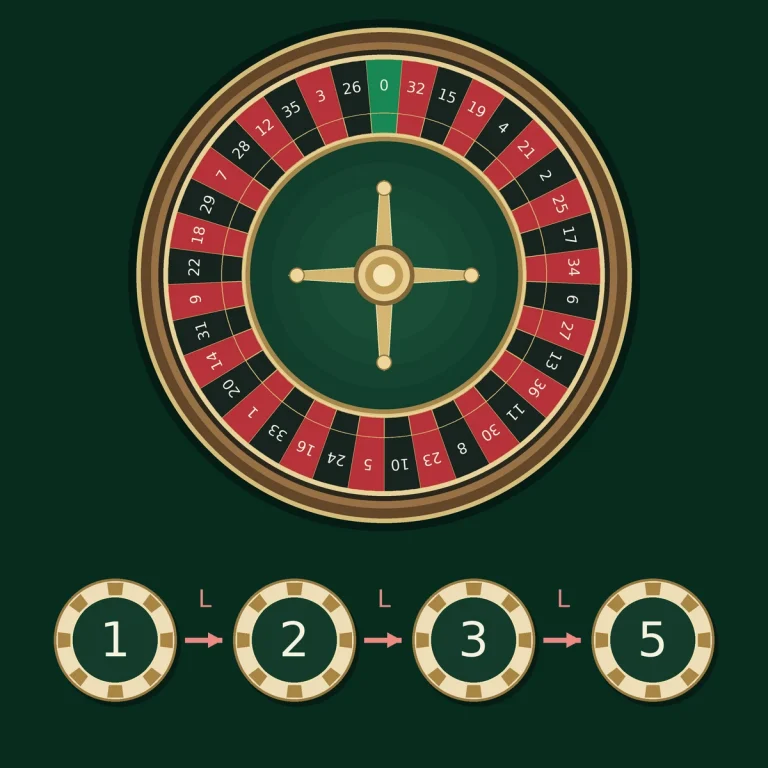
This betting progression sizes even-money wagers from a number sequence rather than doubling after every loss. In the formal version used here, the working stakes are 1, 2, 3, 5, 8, 13…: move one step forward after a loss and two steps back after a win.
What is the Fibonacci roulette strategy?
The Fibonacci roulette system is a negative progression built from the sequence 1, 1, 2, 3, 5, 8, 13 and so on. In the formal betting version used on this page, the working stakes start on the second 1: move forward one Fibonacci position after a loss and move back two positions after a win.
The system changes stake size, not roulette probability. It can grow more slowly than Martingale during a losing run, but every accepted wager still carries the house edge of the selected wheel. The roulette strategy and bankroll-risk guide compares Fibonacci with other progression systems without treating the sequence as a way to predict the next result.
Does the Fibonacci roulette system work?
It works as a defined progression and can complete many cycles with a small target gain. It does not create positive expected value. Longer losing paths move the stake into larger Fibonacci terms, and every finite bankroll or table maximum eventually creates a stopping point.
Fibonacci roulette path calculator
Enter a W/L sequence to reconstruct every stake and state transition. The tool stops when the target is reached, bankroll is insufficient or the required Fibonacci stake exceeds the table maximum.
The sequence LLLWLWW reaches the one-unit target after seven rounds. The realised path wins 10.00 units after wagering 170.00 units, but the same amount of European even-money action carries a 4.59-unit mathematical cost benchmark.
| Round | Sequence position | Stake (units) | Outcome | Gross returned (units) | Round net (units) | Running net (units) | Next state |
|---|---|---|---|---|---|---|---|
| 1 | F2 · 1 | 10.00 | Loss | 0.00 | −10.00 | −10.00 | F3 · 2 |
| 2 | F3 · 2 | 20.00 | Loss | 0.00 | −20.00 | −30.00 | F4 · 3 |
| 3 | F4 · 3 | 30.00 | Loss | 0.00 | −30.00 | −60.00 | F5 · 5 |
| 4 | F5 · 5 | 50.00 | Win | 100.00 | +50.00 | −10.00 | F3 · 2 |
| 5 | F3 · 2 | 20.00 units | Loss | 0.00 units | −20.00 units | −30.00 units | F4 · 3 |
| 6 | F4 · 3 | 30.00 | Win | 60.00 | +30.00 | 0.00 | F2 · 1 |
| 7 | F2 · 1 | 10.00 | Win | 20.00 | +10.00 | +10.00 | Goal reached |
How the Fibonacci roulette system works
Set a target and base unit B. Begin on the second 1 in the sequence, which creates the working stake list B, 2B, 3B, 5B, 8B and so on.
After a loss, advance one sequence position. After a win, move back two positions. If that movement goes before the start of the working list, the cycle ends with the target reached.
Starting on the second 1 matters. Beginning on the first mathematical 1 can create a push after an initial loss followed by a win, while the formal version aims to close the cycle with a one-unit gain.
Why one win may not finish the cycle
One win does not necessarily recover the earlier losses. A winning wager moves the state back two places but does not automatically reset the progression.
For example, losses at 1B, 2B and 3B create a 6B deficit. A 5B win reduces that deficit to 1B and moves the next stake back to 2B. More outcomes are still needed to reach the target.
This creates paths with mixed wins and losses, which is why the calculator reconstructs the state transition rather than treating the system as a simple consecutive-loss ladder.
Returning to the base stake is not always a completed cycle
With a 10-unit base, LLW places 10, 20 and 30. The win recovers the two losses exactly, leaving 0 net and a next stake of 10 at F2. The one-unit target has not been reached; another win is needed to finish at +10.
Stop and reset modes answer different questions
For the entered sequence WLL, with a 10-unit base and bankroll/table limit of 100:
Peak drawdown follows the whole processed path. In the reset example, the bankroll first rises from 100 to 110, then falls to 80. Peak drawdown is 30, although the final balance is only 20 below the starting amount. Resetting the sequence does not erase that decline.
Fibonacci stake and bankroll formulas
Let F₁ = 1, F₂ = 1 and Fₙ = Fₙ₋₁ + Fₙ₋₂. Because the betting sequence starts at F₂, the next stake after n consecutive losses is B × Fₙ₊₂.
The first n lost stakes sum to B × (Fₙ₊₃ − 2). Funding those losses and the following wager requires B × (Fₙ₊₄ − 2).
Next stake after n consecutive losses = B × Fₙ₊₂ Cumulative loss after n consecutive losses = B × (Fₙ₊₃ − 2) Capital required through the next wager = B × (Fₙ₊₄ − 2)Fibonacci roulette chart: consecutive-loss progression
The table is expressed in base-unit multiples. It describes a pure loss run from the starting state, not every possible mixed W/L path.
| Losses before next bet | Fibonacci term | Next stake multiple | Cumulative loss | Capital through next bet |
|---|---|---|---|---|
| 0 | F2 | 1 | 0 | 1 |
| 1 | F3 | 2 | 1 | 3 |
| 2 | F4 | 3 | 3 | 6 |
| 3 | F5 | 5 | 6 | 11 |
| 4 | F6 | 8 | 11 | 19 |
| 5 | F7 | 13 | 19 | 32 |
| 6 | F8 | 21 | 32 | 53 |
| 7 | F9 | 34 | 53 | 87 |
| 8 | F10 | 55 | 87 | 142 |
| 9 | F11 | 89 | 142 | 231 |
| 10 | F12 | 144 | 231 | 375 |
Fibonacci versus Martingale
Martingale doubles after every loss: 1, 2, 4, 8, 16, 32… The formal Fibonacci progression instead advances through successive terms from F₂.
After eight consecutive losses, Fibonacci has wagered 87B, while Martingale has wagered 255B. The slower growth reduces the immediate capital requirement.
The trade-off is recovery speed. Martingale is designed so one full 1:1 win closes a correctly doubled loss run; Fibonacci often requires several later wins because each win moves back only two positions.
Bankroll and table-limit failure
Each stake must satisfy two conditions: the table must accept it, and the remaining bankroll must fund it after all earlier path results.
The loss-capacity cards test a consecutive-loss run from the starting state. They do not calculate the overall probability that a cycle eventually fails: mixed W/L paths can also reach a blocking state. The path table checks the particular sequence entered.
A slower progression is still unbounded. The Fibonacci terms eventually exceed every finite bankroll and position maximum.
For background on table rules and available game formats, see https://roulettecalc.com/casinos/. Use the actual maximum for the even-money position when checking a progression.
Why the system does not change expected value
At every decision point, the next stake is determined from past results. Under an independent wheel model, those results do not change the probability of the next red, black, odd, even, low or high outcome.
Conditional on the full history, a European even-money stake still loses 1/37 of its amount in expectation and an American stake loses 2/38. Adding those conditional costs across a path preserves the wheel’s house edge.
Expected cost of the next stake | past history = stake × house edge Expected strategy result = −house edge × expected total actionThe calculator labels total action × edge as a cost benchmark for the processed path. It is not a prediction of the displayed W/L sequence, whose realised result is already known. The roulette RTP and expected-loss calculator provides the wheel-level house-edge baseline independently of this progression state.
Published large-simulation results
Wizard of Odds reports simulations covering tens of billions of sessions. In the cited single-zero results, an 11-unit bankroll reached the one-unit goal about 90.65% of the time, while a 142-unit bankroll reached it about 99.06% of the time.
The expected session result nevertheless became more negative as the bankroll increased: approximately −0.1224 units at 11 units of capital and −0.3426 units at 142 units.
The larger bankroll increased the chance of a small completed-cycle gain by allowing more action before failure; it did not turn the progression positive.
European versus American roulette
The European model uses even-money bets that win on 18 pockets and lose on 19. The American version wins on 18 and loses on 20 because both 0 and 00 are losing results.
The higher American loss probability makes forward moves more frequent and backward moves less frequent. Wizard of Odds reports lower goal-reaching probabilities and more negative expected results for comparable double-zero bankrolls.
The sequence rules are unchanged, but the wheel probability makes the American implementation mathematically worse.
Which roulette bets fit the classic model?
The W/L transition assumes a full 1:1 win or a full loss. It applies to red/black, odd/even and 1–18/19–36 under standard zero treatment.
Dozens, columns and inside bets use different payout ratios. La partage and surrender create half losses, while en prison creates a held state. Those outcomes require different transition rules and are deliberately excluded.
The outcome sequence field also assumes the same chosen even-money position on every round. Switching between colors or bet types does not alter the arithmetic but makes the entered history harder to interpret consistently.
A progression can organize stake sizes, but it cannot make the next roulette result depend on the previous one. Stop conditions and spending limits matter more than the apparent smoothness of the sequence.
Related progression comparisons
Compare the stake paths below to see how fixed bets, doubling, linear increases and cancellation rules change the amounts at risk.
Common questions about Fibonacci roulette
What is the Fibonacci sequence used in roulette?
The mathematical sequence begins 1, 1, 2, 3, 5, 8, 13 and continues by adding the previous two terms. The formal betting version on this page starts on the second 1 and uses 1, 2, 3, 5, 8, 13… as the working stake multiples.
How does the Fibonacci roulette system work?
Move forward one Fibonacci position after a full loss and move back two positions after a full 1:1 win. If the backward move passes the beginning of the working sequence, the target cycle is complete.
What happens after a loss?
Move one position forward and multiply the new Fibonacci term by the base unit.
What happens after a win?
Move back two positions. If that movement goes before the start of the working sequence, the target cycle is complete.
Does one win recover every Fibonacci loss run?
No. A win moves the progression back two places but may leave part of the earlier deficit. Several wins can be required.
Is Fibonacci safer than Martingale?
It grows more slowly during consecutive losses, but it still faces finite bankrolls, table limits and negative expected value. “Slower” does not mean risk-free.
Can Fibonacci beat European roulette?
No. Each standard even-money stake retains the 2.70% European house edge. Dynamic stake sizing changes total action and result distribution, not the edge.
Rule and analysis sources
- Wizard of Odds — formal Fibonacci rules, second-one starting point, worked example and large simulations.
- Wizard of Odds — why betting systems do not remove negative expected value.
- 58 Pa. Code § 617a.1 — single-zero and double-zero wheel structures.
- 58 Pa. Code § 617a.4 — 1:1 even-money payouts and losses on 0 or 00.
Was this tool helpful?
What went wrong?
For calculation problems, inputs and results are attached to your report.