Roulette Bet Types: Inside, Outside and Zero-Area Bets
Roulette bet types are defined by chip position and coverage. A chip inside one box covers one pocket, while a chip on a line or intersection can cover two, three, four or six numbers. Outside boxes collect larger fixed groups such as dozens, columns, colors and ranges.
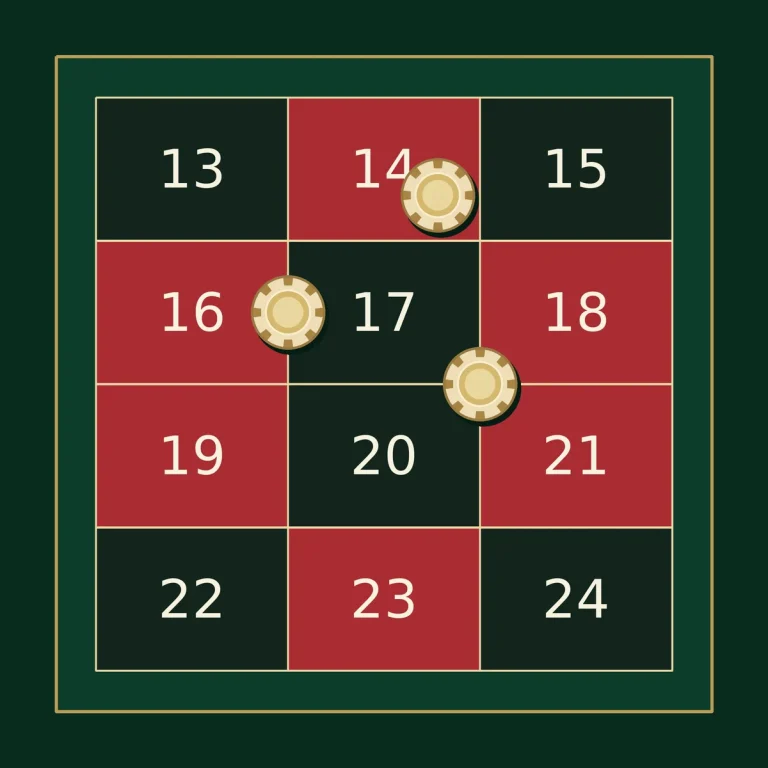
Interactive bet placement explorer
Choose a wheel, bet type and example position. The map highlights every covered pocket; the accompanying text explains the chip position, standard payout, probability and gross return.
European layout coverage
Use the menus above to change the wager; the numbered boxes are a coverage display. This simplified map omits outside betting boxes and exact zero-area boundaries. Read the placement description and the actual table layout for the chip position.
Place the chip inside the box for 17. Only that pocket wins.
How to bet on roulette
Roulette betting works by placing chips on the table position that represents the pocket or group of pockets you want to cover before betting closes. Start by choosing the table and then the exact position: a chip inside one number is a straight bet; a chip on a dividing line or intersection creates an inside combination; a chip in a labeled outside box selects a dozen, column, color, parity or range.
Inside roulette bets and placement
Inside roulette bets use the numbered grid and the zero area. Straight wagers sit inside one box. Splits sit on a line between two boxes. Streets use an outside row edge, corners use a four-box intersection and six lines use the outer corner shared by two adjacent rows. The roulette wheel and table layout guide shows the full grid and explains how table adjacency differs from circular wheel order.
Inside bets cover fewer pockets than outside groups, so their listed payouts are larger. That does not make them mathematically better: on a standard wheel, payout and coverage are designed to preserve the wheel’s normal house edge.
What is a street bet in roulette?
A street bet covers one horizontal row of three numbers and pays 11:1. It is placed on the outside edge of that row. A double street, usually called a six-line bet, covers two adjacent rows for six numbers and pays 5:1; the chip sits on the outside corner shared by the two rows.
Zero-area placements require extra attention because the shape differs between single-zero and double-zero layouts.
What are outside bets in roulette?
Outside roulette bets use labeled boxes surrounding the main grid. Columns and dozens each cover twelve numbers. Red, black, odd, even, 1–18 and 19–36 each cover eighteen numbered pockets.
Zero and 00 are excluded from standard outside groups. Under the standard Pennsylvania rule, red, black, odd, even, 1–18 and 19–36 wagers lose when 0 or 00 lands. This is why an even-money wager has less than a 50% hit probability despite paying 1:1.
La partage, en prison and surrender can change how selected even-money stakes settle when a green pocket lands, but they do not add zero to the group’s normal coverage.
Roulette bet types, placement and payouts
This table separates the physical chip position from the numbers covered. Payout ratios are net profit; the original winning stake is also returned. Use the roulette payout calculator for stake-specific gross return and net profit, and the roulette odds calculator when the question is one-spin or repeated-spin probability.
| Bet type | Chip position | Coverage | Net payout | Availability |
|---|---|---|---|---|
| Straight | Inside one numbered box | 1 pocket | 35:1 | Both wheels |
| Split | Line between two adjacent boxes | 2 pockets | 17:1 | Layout dependent |
| Street | Outside edge of one three-number row | 3 pockets | 11:1 | 1–36 grid |
| Zero trio | Common corner of three zero-area boxes | 3 pockets | 11:1 | Wheel specific |
| Corner | Intersection of four adjacent boxes | 4 pockets | 8:1 | 1–36 grid |
| First four | 0-1-2-3 zero-area position | 4 pockets | 8:1 | Single zero |
| First five | Corner shared by 1st 12, 0 and 1 | 5 pockets | 6:1 | Double zero |
| Six line | Outer corner shared by two rows | 6 pockets | 5:1 | 1–36 grid |
| Dozen | 1st 12, 2nd 12 or 3rd 12 box | 12 pockets | 2:1 | Both wheels |
| Column | 2 to 1 box below the selected column | 12 pockets | 2:1 | Both wheels |
| Even-money | Named outside box | 18 pockets | 1:1 | Zero excluded |
| Split dozen / column | Intersection between two outside boxes | 24 pockets | 1/2:1 | Table specific |
Zero-area roulette bets
On a single-zero layout, common zero-area positions include straight 0, splits involving 0, the 0-1-2 and 0-2-3 trios, and first four on 0-1-2-3. The exact printed shape determines which line or corner is used.
A double-zero layout adds straight 00, the 0-00 split, 0-2-00 and 00-2-3 trios, and first five on 0-00-1-2-3. A triple-zero roulette layout adds a third green outcome and requires its own zero-area and payout model. First five is not simply another five-number version of a normal inside bet: its 6:1 payout creates a 7.89% house edge.
Dozen, column and even-money groups
Dozens divide 1–36 into three consecutive ranges. Columns divide the same grid vertically. Both groups cover twelve pockets and pay 2:1.
Even-money groups cover eighteen numbers: one color, one parity or one half of the 1–36 range. Their 1:1 payout returns one unit of profit for each unit staked.
No standard dozen, column or even-money wager includes 0 or 00.
Compound and announced bets
Some familiar names describe packages of standard roulette bets rather than one new table position. Neighbor selections split a total stake across consecutive wheel pockets. Voisins du zéro, tiers du cylindre and orphelins distribute chips across several splits, trios, corners or straight wagers in defined wheel sectors; the roulette sectors and call-bets calculator breaks those announced packages into their component chips and coverage.
The snake bet is another compound selection, normally covering twelve red numbers that form a winding shape on the grid. Because these packages contain multiple component bets, their total stake and pocket-by-pocket return depend on how the chips are distributed.
When a wager contains more than one standard position, use the combined-bet outcome calculator; a single payout ratio may not describe every covered result. The James Bond roulette strategy is a clear example: its fixed 14:5:1 package produces different net results across high numbers, 13–18, zero and uncovered pockets.
How to compare roulette bets correctly
- Start with coverage. Count the exact pockets included by the chip position.
- Read payout as net profit. A winning stake is returned in addition to the listed ratio.
- Check the wheel model. Zero-area positions and one-spin probabilities differ.
- Separate hit rate from house edge. More frequent wins do not automatically mean a better expected return.
- Check table-specific rules. Split dozens, split columns and announced bets may not appear everywhere.
- Break compound wagers into components. Overlapping positions can produce different returns by pocket.
Compare the same 12-unit budget
Each pair covers the same pockets, loses all 12 units on an uncovered result and has the same return for every possible outcome under standard fixed payouts. The different printed payout ratios do not create a different risk profile in these equal-budget examples. Table minimums and chip denominations may affect whether both arrangements can be placed.
Try your own equal-budget comparison
Keep the total stake and covered numbers identical. Compare one group position with equal stacks on its individual numbers, then choose a hypothetical winning pocket to see what is returned.
- Total stake
- Gross returned on the selected pocket
- Net after all stakes
- Total stake
- Gross returned on the selected pocket
- Net after all stakes
See both possible net results and their probabilities
| Outcome | Chance | Net result |
|---|---|---|
| Any other pocket |
This comparison uses standard fixed payouts: street 11:1, dozen 2:1 and straight 35:1. Losing straight stakes are included in the net result. It does not model multipliers or special zero rules. Matching results do not guarantee that a table accepts both arrangements: check inside and outside minimums, chip values and maximum bets.
Compare roulette casino tables by available bet formats when checking a game's minimums, zero rules and accepted positions. This explorer uses standard fixed payouts; special even-money zero rules are outside its calculation.
No roulette bet predicts the winning number. Placement changes coverage, payout frequency and variance, but standard wagers retain the wheel’s built-in mathematical disadvantage.
What is the best roulette bet?
There is no single standard bet that is best for every objective. On the same standard wheel, most ordinary inside and outside bets share the same house edge; what changes is the hit rate, payout size and volatility.
- Highest common hit rate: red/black, odd/even and low/high each cover 18 numbers, so they win more often than inside bets but pay only 1:1.
- Highest standard single-position payout: a straight bet pays 35:1, but it covers only one pocket.
- Lower-edge rule choice: qualifying even-money bets under French la partage can reduce the house edge compared with standard European or American roulette.
- Bet to avoid when minimizing edge: the American first five pays 6:1 on five pockets and carries a 7.89% house edge.
“Best” should therefore mean the trade-off that matches the goal—lower house edge, higher hit rate, higher payout or lower volatility—not a bet that predicts or guarantees the next result.
Use the calculation that matches the question
Use the placement explorer to identify covered pockets. For a monetary return, use the payout calculator; for repeated-spin probabilities, use the odds calculator. When several wagers overlap, calculate the complete package so that losing components are deducted from winning returns.
For a worked layout with several winning bets, follow the chip-stack counting example and then try the practice questions.
Common questions about roulette bets
What is the difference between inside and outside bets?
Inside wagers use numbered boxes, lines and intersections and cover one to six pockets. Outside wagers use named boxes and usually cover twelve or eighteen pockets.
What roulette bet covers one number?
A straight wager covers exactly one pocket and pays 35:1 in net profit when that pocket wins.
Which roulette bet covers the most numbers?
Among common single outside positions, an even-money wager covers eighteen numbers. Some table-specific split dozen or split column positions cover twenty-four, but pay only 1/2:1.
Is zero included in red, black, odd or even?
No. Zero and double zero are green pockets and are excluded from standard color, parity, low/high, dozen and column groups.
What is the worst standard roulette bet?
On a standard American table, first five has the highest usual house edge at 7.89%. Other standard American wagers have a 5.26% edge.
Do outside bets have better RTP?
Not under standard rules. On the same wheel, normal inside and outside wagers usually share the same house edge even though their hit rates and payouts differ.
Primary sources for placement and payouts
- 58 Pa. Code § 617a.3 — chip placement and coverage definitions for straight, split, three-number, four-number, first-five, six-number, column, dozen and even-money wagers.
- 58 Pa. Code § 617a.4 — standard payout odds, first five at 6:1 and the standard loss of even-money wagers on 0 or 00.
- Casino de Monte-Carlo — European zero-area wagers, first four, split dozen and split column rules.
Was this tool helpful?
What went wrong?
For calculation problems, inputs and results are attached to your report.