Roulette Calculator
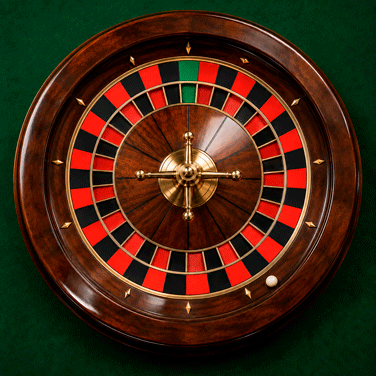
Use this all-in-one tool for a quick estimate of one roulette bet: its hit probability, return if it wins, expected loss over several spins and chance of at least one hit. Open the specialist calculators when you need exact hit counts, target-stake planning or detailed wheel rules.
Run a complete roulette estimate
Choose the wheel, bet type, stake and number of spins. The tool summarizes probability, winning return and long-term cost in one result panel.
Current calculation
A $10.00 straight bet on European roulette covers 1 of 37 pockets. If it wins, the net profit is $350.00 and the gross return is $360.00 including the returned stake.
Compare two scenarios
A stays fixed. B follows the fields above. Differences are B minus A; a larger payout alone does not make a bet better.
| Measure | A · Saved | B · Current | Difference |
|---|
pp = percentage points. Expected loss is a long-run average, not a forecast; values below one cent use extra decimal places. Percentage differences are rounded to two decimal places. For French even-money bets, a zero is a half-loss and counts as a miss.
Scenario A is kept for this page visit only. Share result shares the current calculation (B), without the saved comparison.
How this roulette calculator works
The calculator first loads the selected layout: 37 outcomes for a single-zero wheel or 38 for the double-zero version.
It measures how much of that layout the chosen bet covers and applies the published winning ratio. For the coverage and table position behind each standard wager, see the roulette bet types and placement guide. When several positions overlap on the same spin, use the combined-bet outcome calculator instead of adding the results manually.
Win probability is kept separate from money returned on a winning spin. For exact one-spin and repeated-spin hit calculations, use the repeated-spin probability tool. For gross return, net profit and reverse target-stake calculations, use the stake and return calculator.
Expected loss is not a prediction for the next spin. It is the long-term mathematical cost of the selected stake size, wheel type and number of spins. The RTP and house-edge calculator isolates that long-run percentage cost, while the roulette session simulator compares random session paths with theoretical results.
How wheel rules change the estimate
European roulette has one zero, so the standard house edge is 1 divided by 37, or about 2.70%. American roulette adds a double zero, raising the base house edge to 2 divided by 38, or about 5.26%. The roulette wheel layout guide maps those pocket counts, zero formats and number order.
French roulette usually uses the same single-zero wheel as European roulette, but rules such as la partage can reduce the cost of even-money bets when zero lands. That reduced edge does not apply to inside bets like straight, split or corner. The wheel and zero-settlement rules explain how these outcomes are handled at the table.
With the same standard bet and payout, a single-zero wheel has a lower expected cost than a double-zero wheel. Zero is a winning outcome when your bet covers it; it is not always a losing pocket. Compare actual table formats and rules at https://roulettecalc.com/casinos/.
Read each result as a different measure
Win probability describes how much of the wheel the selected bet covers. Across repeated spins, the chance of at least one hit rises, but the probability of any individual spin does not change because previous results do not alter the wheel.
Gross return includes the original stake returned after a win. Net profit excludes that returned stake, so a $10 straight bet that wins at 35:1 shows $350 net profit and $360 gross return.
Expected loss is a long-run average based on total stake and house edge, not a forecast for the current session. A short session can finish above or below that average because actual results vary around the mathematical expectation.
A hit is not the same as a profitable session. If a $10 straight bet hits once in 40 spins and misses the other 39, its $360 gross return is less than the $400 wagered: the session finishes $40 down. The at-least-one-hit result does not calculate your chance of finishing ahead.
Total wagered is turnover, not starting bankroll. The estimate assumes you place the same stake on every selected spin, with independent, equally likely pocket outcomes. It does not stop early for a depleted bankroll, a profit target or a table limit.
What the calculator cannot do
The tool cannot predict the next number, color or section of the wheel. Each spin is treated as an independent event, and previous spins do not make a number due.
Betting systems such as Martingale or Fibonacci can change how quickly a bankroll rises or falls, but they do not remove the house edge built into the wheel. The bankroll-risk and betting-system guide compares those progressions without treating them as a way to beat roulette.
Use the results as a risk and payout estimate, not as a signal for choosing the next number. The spin-history analysis tool explains what observed frequencies can tell you; the fairness and settlement checks separate a surprising sequence from evidence about a game or payment.
Choose a specialist roulette calculator
The main roulette calculator gives a compact overview. Use a specialist page when probability, return, RTP or one wheel type is the primary question.
The overview uses standard payouts and immediate la partage settlement. For other models, use the 39-pocket calculator or Lightning payout calculator. En prison is available in the French tool below; it is not simulated on this page.
Questions about choosing a calculator
Which roulette calculator should I use?
Use the main calculator for a quick combined estimate of hit chance, winning return and expected loss. Use the specialist pages when one of those measures needs a deeper calculation.
Where can I calculate the stake needed for a target win?
The payout and target-stake tool reverses the standard payout formula and rounds the required stake upward so the selected target is not understated.
Where can I calculate exact hits or losing streaks?
The probability calculator models exactly X hits, at least X hits and the chance that a chosen run of consecutive misses appears within the selected spins.
Does the main calculator include house edge?
Yes. It uses the selected wheel and rule to estimate expected loss. The separate RTP calculator provides the more detailed long-term comparison.
Can any of these tools predict the next spin?
No. They calculate probability, return and long-term expectation from fixed roulette rules. They do not identify the next number, color or section.
Was this tool helpful?
What went wrong?
For calculation problems, inputs and results are attached to your report.