Roulette Bet Calculator
Combine multiple roulette bets on one spin and see what happens on every pocket. The tool totals your stake, accounts for overlapping winners and separates gross return from the final net result.
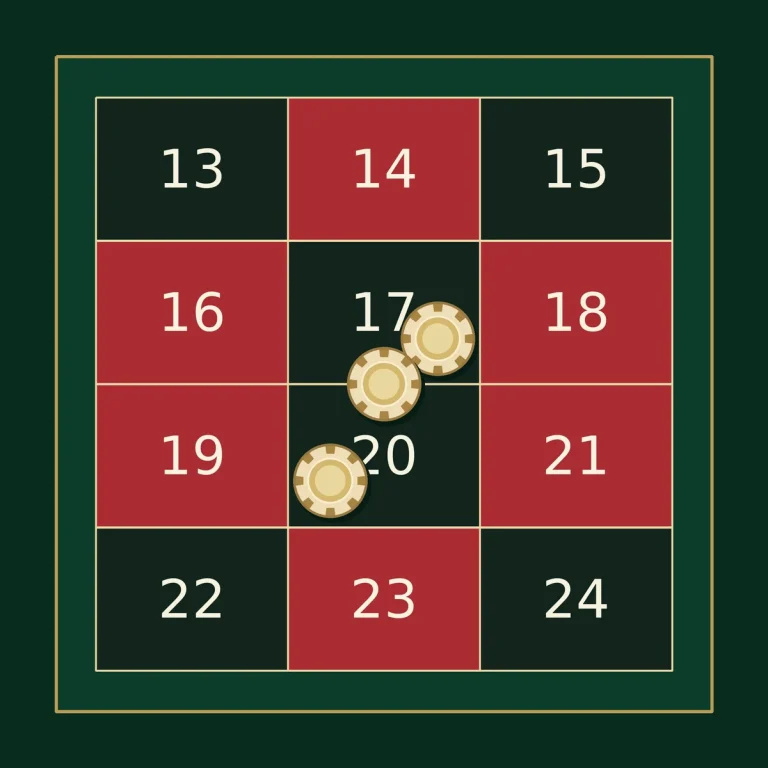
Calculate multiple roulette bets on one spin
Select the wheel, add up to 20 bets and enter a stake for each row. This multiple-bet roulette calculator maps each configured position to the wheel and combines all returns on overlapping outcomes.
Explore three bet mixes
Each example replaces the bet rows using your selected wheel and display currency. These are learning examples, not betting recommendations. You can undo the last example load.
Example from the strategy guide
Choose a position on the table
Choose a bet type, then select its numbers. For a split, select two boxes sharing an edge; for a corner, select all four boxes. Your draft changes the live rows only when you press Add or Replace.
Zero area: separate selectors. Supported combinations follow the chosen wheel model.
✓ = draft selection. Underline = covered by a valid live row. Coverage does not mean a profitable outcome.
Selecting an existing row loads it for editing. Repeated positions remain separate rows; stakes are never merged automatically. The limit is 20 rows. The table is a placement aid, not a wheel-order map.
Split a budget across your rows
Set a budget for one spin, not your session bankroll. Preview equal stakes in whole chips; your current stakes change only when you apply the allocation.
Unallocated money stays outside the bet. Adding or removing a row updates the preview; apply again to redistribute. Manual stakes need not follow this chip value. Check the actual table minimums and limits.
Preview a full complete placement
| Position | Pockets | Base chips | Stake in units |
|---|
Applying replaces all live rows, selects the European wheel and betting units, and sets the inspected result to the complete-bet number. The saved A comparison stays unchanged. Undo restores the previous rows, wheel, currency and inspected result until those live settings change. This link carries a number and base-unit value for the stated single-zero model, not arbitrary bets or verified casino limits.
The example stakes $5 on straight 23 and $5 on red. Pocket 23 returns both bets for a $180 net profit; other red numbers break even; black numbers and zero lose the full $10 stake.
Trace the return on one number
Choose a hypothetical result to settle every row. This does not generate or record a spin. Gross return includes the winning stake; net result also accounts for losing rows.
| Bet row | Stake | Result | Gross return | Net result |
|---|
| Winning bets | Gross return | Net result |
|---|
Do two placements pay the same?
Save your current rows as A, then edit the builder to make B. The comparison updates as you edit. Equal coverage or an equal chance of profit does not mean the same payout on each number.
View saved A
| Measure | A | B |
|---|
Compare every possible pocket
Delta is B minus A. Gross includes returned winning stakes; net subtracts all stakes on that spin. A zero delta alone does not prove the budgets are equal.
| Gross A | Gross B | Net A | Net B | Net delta |
|---|
Try it: a street versus three straight bets
Enter 3 units on street 1,2,3 and save A. For B, enter 1 unit straight on each of 1, 2 and 3. Both stake 3, return 36 when one of those numbers wins and lose 3 otherwise. Now change B to 0.50 on 1, 1 on 2 and 1.50 on 3: the budget and covered numbers stay the same, but the returns change.
Exact equivalence here requires the same wheel, total stake and gross/net return on every pocket. Matching only the distribution of net results means the same probabilities on a fair wheel, but potentially different winning numbers. Standard EU/US payouts only; no La Partage, En Prison or multipliers. The single-position check searches supported placements at the same total stake, without changing your rows or checking a casino's chip rules and limits. A is kept only on this page; reloading clears it. Changing display currency relabels both sets without conversion.
How combined roulette bets are calculated
Each row in the calculator is settled independently at its standard payout. When an outcome is covered by more than one row, the gross returns from all winning rows are added together.
The calculator then subtracts the full amount staked across the slate, including losing rows. This last step is why a payout that looks large in isolation can become a smaller profit, a break-even result or a net loss after the other stakes are included. For a single component before it is mixed into the slate, use the winning return and target stake calculator.
Total stake = stake 1 + stake 2 + … Outcome gross return = sum of gross returns from winning bets Outcome net result = gross return − total stakeOverlap changes the outcome, not the payout ratio
A straight bet on 23 still pays 35:1 when it is combined with red, a dozen or another position. The individual payout does not change, but the final result does because several rows can win or lose together.
Overlapping bets can create a small set of high-return pockets while leaving other covered pockets at break-even. They can also increase the total stake faster than they increase profitable coverage.
Use the outcome table rather than adding headline payout ratios. Ratios describe individual bets; the table describes the complete slate.
Coverage, break-even and profit are different
The roulette bet calculator reports three separate outcome groups. A covered pocket is any pocket where at least one row returns money. A profitable pocket produces a gross return above the total stake. A break-even pocket returns exactly the total amount placed.
This distinction is important for wide systems. Placing equal stakes on all three dozens covers numbers 1–36, but each winning dozen returns only the combined stake. The slate breaks even on 36 pockets and loses everything on zero.
Adding more covered pockets can reduce the size of a loss or create more break-even outcomes, but standard payouts still preserve the wheel's mathematical edge.
Examples of overlapping roulette bets
These examples use a European single-zero wheel and standard payouts. They show why the complete net result matters more than the payout label on one row.
| Bet mix | Outcome | Gross return | Net result |
|---|---|---|---|
| 5 on straight 23 + 5 on red | 23 | 190 | +180 |
| Same straight-and-red mix | Another red number | 10 | 0 |
| Same straight-and-red mix | Black or zero | 0 | −10 |
| 10 on first dozen + 10 on second dozen | 1–24 | 30 | +10 |
| 10 on first dozen + 10 on second dozen | 25–36 or zero | 0 | −20 |
| 5 on each of three dozens | 1–36 | 15 | 0 |
| 5 on each of three dozens | Zero | 0 | −15 |
For named European racetrack packages, the call bets calculator breaks Voisins, Tiers, Orphelins, Jeu Zéro and neighbour selections into their component chips. For the fixed 14:5:1 package, the James Bond outcome map shows the same pocket-by-pocket net-settlement approach used here.
What the builder validates
Preset outside bets automatically use the correct number sets. Manual entries are checked for pocket count, duplicates, wheel membership and valid placement on the selected layout. A split must share a table edge; a street must fill one row; a corner must cover a four-box intersection; a six line must fill two adjacent rows.
Zero-area positions follow the layouts in our bet placement guide. European splits are 0/1, 0/2 and 0/3; trios are 0,1,2 and 0,2,3. Use Corner for first four on 0,1,2,3. American splits are 0/00, 0/1, 0/2, 00/2 and 00/3; trios are 0,1,2; 0,00,2; and 00,2,3. American first five covers 0,00,1,2,3. Six lines cannot include either zero.
These are standard three-column layout models, not a scan of your casino table. Zero-area markings and offered bets can vary, so check the actual table rules. Invalid rows remain editable and block the combined results until corrected; changing the wheel checks every row again.
For differences between operators, our roulette lobby and table comparisons cover available game formats and rule sets. Check the selected table's own rules and limits before applying a bet mix.
Expected loss for a mixed slate
For a mixed slate, this roulette bet calculator averages the net results across every equally likely pocket. Dividing the expected loss by total stake gives the effective edge of the complete mix.
For standard European bets, combining positions normally retains the 2.70% edge. Standard American bets normally retain 5.26%, while the American first five carries a larger 7.89% edge and can raise the weighted edge of a mixed slate.
Overlap changes volatility and the distribution of results. It does not turn standard negative-expectation bets into a positive-expectation system.
Related probability and wheel tools
Explore repeated-spin probabilities, long-term expected loss and the wheel layout with these related tools.
Common questions about combined bets
How do you calculate multiple roulette bets?
Calculate the gross return of every bet that wins on the selected pocket, add those returns and subtract the total amount staked across all rows.
Can two roulette bets win on the same number?
Yes. For example, straight 23, red, the second dozen and the second column all include 23. If all four are selected, each winning return is added on that outcome.
Does covering more numbers guarantee a profit?
No. Wider coverage can create more returned or break-even outcomes, but the combined payout may still be smaller than the total stake and zero pockets still preserve the house edge.
What if a winning bet returns less than the total stake?
The outcome is still a net loss. The tool labels a pocket as covered when at least one row returns money, then separately checks whether the combined gross return exceeds the total stake.
Can I enter 00 on a European wheel?
No. Double zero exists only on the American layout. Switch the wheel to American before using 00, the 0–00 split or the first-five bet.
Does this roulette bet calculator validate table adjacency?
Yes. Splits, streets, corners and six lines must match a valid position on the selected standard layout, including its supported zero-area bets. Adjacency means neighboring boxes on the betting table, not neighboring pockets around the wheel. Check table-specific zero-area rules before using the result.
Was this tool helpful?
What went wrong?
For calculation problems, inputs and results are attached to your report.