James Bond Roulette Strategy Calculator and Outcome Map
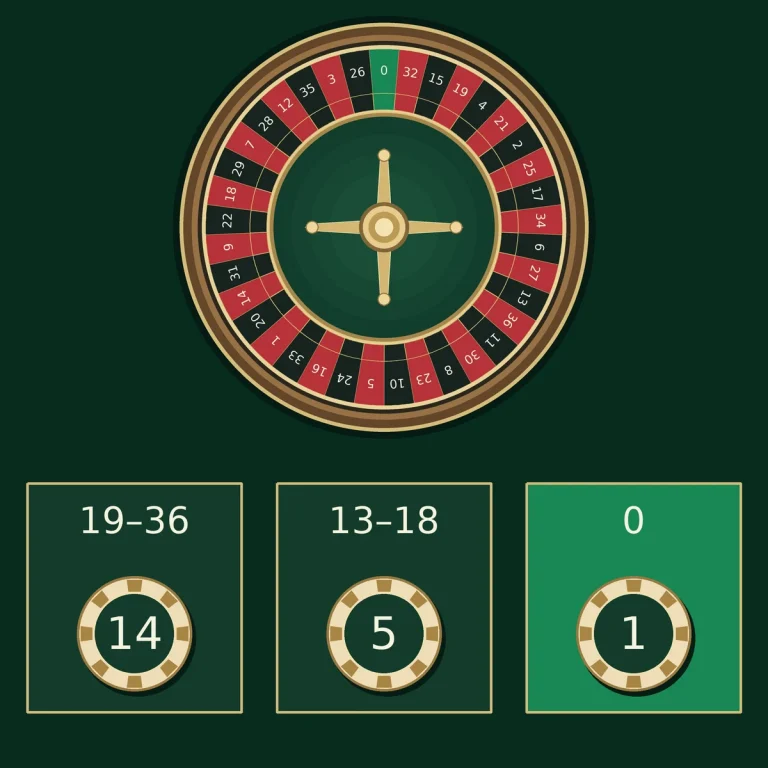
The conventional 14:5:1 system divides every spin into twenty units: fourteen on 19–36, five on the six-line bet covering 13–18 and one on zero. It covers 25 European pockets, but coverage is not the same as a mathematical advantage.
What is the James Bond roulette strategy?
The conventional allocation divides every spin into twenty units: fourteen units on 19–36, five units on the six-line covering 13–18 and one unit straight on zero. On a European wheel this package covers 25 of 37 pockets and produces a positive spin result on every covered pocket.
The high hit rate does not create a mathematical advantage. The uncovered 1–12 group loses the full twenty-unit package, so the expected loss remains the normal 2.70% European house edge on total action. The roulette strategy and bankroll-risk guide compares this fixed allocation with progression systems and flat betting.
Does the James Bond roulette strategy work?
It works as a fixed coverage plan: the stake allocation and every possible net result are known in advance. It does not beat the house edge. A European spin finishes ahead 25/37 of the time, but the less frequent full-loss outcome is large enough to keep expected value negative.
James Bond roulette calculator
Choose the canonical single-zero model or one of two explicitly labeled American adaptations. The tool scales the 14:5:1 allocation, maps every possible outcome and calculates the exact flat-session distribution without simulation.
The European version has three profitable result groups and one full-loss group. Its 67.57% profitable-spin rate coexists with negative expectation because a 1–12 result loses the entire twenty-unit package.
| Winning result | Pockets | Component that wins | Gross returned | Net spin result | Probability |
|---|---|---|---|---|---|
| 19–36 | 18 | High bet · 14 units at 1:1 | 28 units | +8 units | 48.65% |
| 13–18 | 6 | Six line · 5 units at 5:1 | 30 units | +10 units | 16.22% |
| 0 | 1 | Straight · 1 unit at 35:1 | 36 units | +16 units | 2.70% |
| 1–12 | 12 | No component wins | 0 units | −20 units | 32.43% |
How to use the James Bond roulette strategy
Choose a strategy unit B. The total spin stake is 20B. Place 14B in the 19–36 high box, 5B on the six-number line covering 13–18 and B as a straight wager on zero.
The proportions are therefore 70%, 25% and 5% of total action. A commonly quoted 200-unit example uses 140 on high, 50 on 13–18 and 10 on zero. The roulette bet-placement guide shows where the high, six-line and straight-zero components sit on the layout.
A 20-unit spin budget means B = 1. The three stakes are 14, 5 and 1. Entering 20 as the strategy unit would instead create a 400-unit package. For table comparisons covering available games and rules, see https://roulettecalc.com/casinos/.
Real tables require the selected unit and all three components to satisfy chip denominations, minimums and position limits. To rebuild the package from individual wagers, change the proportions or inspect other overlapping combinations, use the multiple roulette bets calculator.
Why three winning groups produce different profits
The high wager returns 28B gross when 19–36 lands, leaving 8B after subtracting the full 20B package. The six-line result returns 30B gross and leaves 10B net.
A zero straight returns 36B gross and leaves 16B net. The system therefore does not create one uniform “win”; it creates three different positive results and one much larger negative result. The roulette payout calculator shows the standard gross and net return formulas behind the high, six-line and straight components.
19–36: 14B × 2 − 20B = +8B 13–18: 5B × 6 − 20B = +10B 0: B × 36 − 20B = +16B 1–12: 0 − 20B = −20BExact European expected value
The canonical structure covers 25 of 37 pockets and produces a positive result whenever 13–36 or zero lands. The remaining twelve pockets lose the complete stake. The European single-zero calculator provides the underlying 37-pocket probability, payout and expected-loss baseline for each component bet.
Weighting each result by its pocket count gives an expected result of −20B/37. Because each spin risks 20B, the percentage loss is exactly 1/37, the normal European roulette house edge.
EV = [18(+8B) + 6(+10B) + 1(+16B) + 12(−20B)] / 37 EV = −20B / 37 House edge = (20B/37) / 20B = 1/37 = 2.70%Coverage is not the same as winning probability
On the canonical European layout every covered pocket produces a profit, so covered probability and profitable probability are both 25/37.
That equivalence breaks in the American 0–00 split adaptation. The split covers both green pockets, but its one-unit stake returns only 18B gross. After subtracting the 20B package, either green result still loses 2B.
The adaptation therefore covers 26 of 38 pockets but finishes ahead on only 24 of 38.
Why American James Bond roulette adaptations are worse
The American straight-zero adaptation leaves 00 completely uncovered. It has 25 profitable pockets and thirteen full-loss pockets, preserving the ordinary 5.26% double-zero edge.
The 0–00 split adaptation reduces full-loss pockets to twelve, but the two green results each lose 2B. Its probability of any negative result is therefore fourteen out of 38.
Changing the green component changes the distribution of losses, not the total expected value. Both American versions lose 2/38 of total action on average. The American double-zero calculator shows the corresponding 38-pocket standard edge, surrender rule and first-five exception outside this package.
European and American outcome comparison
| Model | Covered pockets | Profitable pockets | Negative pockets | Full-loss pockets | RTP | House edge |
|---|---|---|---|---|---|---|
| European canonical | 25/37 · 67.57% | 25/37 · 67.57% | 12/37 · 32.43% | 12/37 | 97.30% | 2.70% |
| American · straight 0 | 25/38 · 65.79% | 25/38 · 65.79% | 13/38 · 34.21% | 13/38 | 94.74% | 5.26% |
| American · 0–00 split | 26/38 · 68.42% | 24/38 · 63.16% | 14/38 · 36.84% | 12/38 | 94.74% | 5.26% |
Why the James Bond roulette strategy can still lose money
The allocation is designed to produce positive results more often than negative ones on a European wheel. The trade-off is size: normal profits are 8B, 10B or 16B, while an uncovered result loses 20B.
A high hit rate is therefore not enough to determine expected value. Both the probability and amount of every outcome must be included.
The exact session distribution in the calculator performs that full convolution rather than multiplying a headline win rate by the number of spins.
What the flat-session probabilities mean
The ahead, break-even and behind figures assume independent spins, the same strategy unit on every round and no progression after a loss. The calculation sums the discrete outcome distribution for the selected round count; displayed percentages are rounded. It assumes every scheduled package is funded, with no early stop, bankroll limit or table-limit check.
The probabilities do not predict one player’s next session. They describe the distribution generated by repeatedly applying the listed outcome map.
Expected loss grows in direct proportion to total action. The probability of finishing ahead need not decrease at every additional round: the possible net totals form a discrete distribution. Changing only the strategy unit scales the money, not these probabilities.
Should the package be doubled after a loss?
Doubling the entire 20-unit package is a separate progression, not part of the flat outcome map above. After n full losses, the next package would cost 20B × 2ⁿ and cumulative package losses would grow geometrically.
The progression does not change the European 2.70% or American 5.26% expected cost applied to total action. It only increases how much money is exposed after previous negative outcomes.
A standard even-money Martingale recovery formula does not apply to this package: a profitable spin can return different amounts. Any progression analysis must track all component bets, the full package cost and the exact outcome sequence.
| After losing a 20-unit package | Next package | Next-spin net | Two-spin net |
|---|---|---|---|
| Double, then hit 19–36 | 40 | +16 | −4 |
| Double, then hit 13–18 | 40 | +20 | 0 |
| Double, then hit 0 | 40 | +32 | +12 |
These are European examples starting at B = 1. A doubled high-number win does not recover the previous full loss; a six-line win only breaks even across the two spins.
The next spin does not become more likely to land in the covered 25 pockets because the previous spin lost. Stake escalation and outcome probability are separate.
Did James Bond really use this roulette system?
The James Bond name is widely used for the 14:5:1 allocation, but its origin is uncertain. A mathematical analysis by Wizard of Odds explicitly notes that the author does not know what the staking pattern has to do with James Bond.
Claims that this exact package was used by the fictional character should therefore be treated cautiously unless they identify a primary passage or scene. The name is not part of the mathematics.
Related probability and house-edge tools
Use the probability tool to examine repeated-spin events and the RTP tool to compare expected cost at the same amount wagered.
Common questions about James Bond roulette
How much do you bet with the James Bond system?
The conventional version uses twenty strategy units per spin: fourteen on 19–36, five on 13–18 and one on zero. A 10-unit strategy unit creates a 200-unit total package.
What numbers does the strategy cover?
The European version covers zero and every number from 13 through 36, for 25 covered pockets out of 37.
What happens when 19–36 wins?
The 14-unit high wager returns 28 units gross. After subtracting all twenty units placed that spin, the net result is plus eight strategy units.
Does the James Bond roulette strategy work?
It works as a fixed 14:5:1 coverage system and produces a positive result on 25 of 37 European pockets. It does not beat the house edge: the full-loss outcomes keep the money-weighted expected result negative.
Why does the James Bond roulette strategy fail to beat roulette?
The profitable spins are smaller than the full-package losses on 1–12. Weighting every possible result by its probability gives the same 2.70% European house edge on total action.
Can it be used on American roulette?
It can be adapted, but the result is not the canonical single-zero pattern. Leaving 00 uncovered or replacing the zero straight with a 0–00 split changes outcome frequencies while retaining the American house edge.
Did James Bond really use this roulette system?
The exact origin of the name is uncertain. The commonly analyzed staking pattern should not be attributed to a specific book or film without a primary source.
Rule and analysis sources
Was this tool helpful?
What went wrong?
For calculation problems, inputs and results are attached to your report.