Paroli Roulette Calculator
The positive progression raises the wager only after wins. A standard cycle doubles the stake, resets after any non-win and also resets after a chosen run of consecutive wins. This calculator follows an exact path and separates completed cycles from unfinished streak exposure.
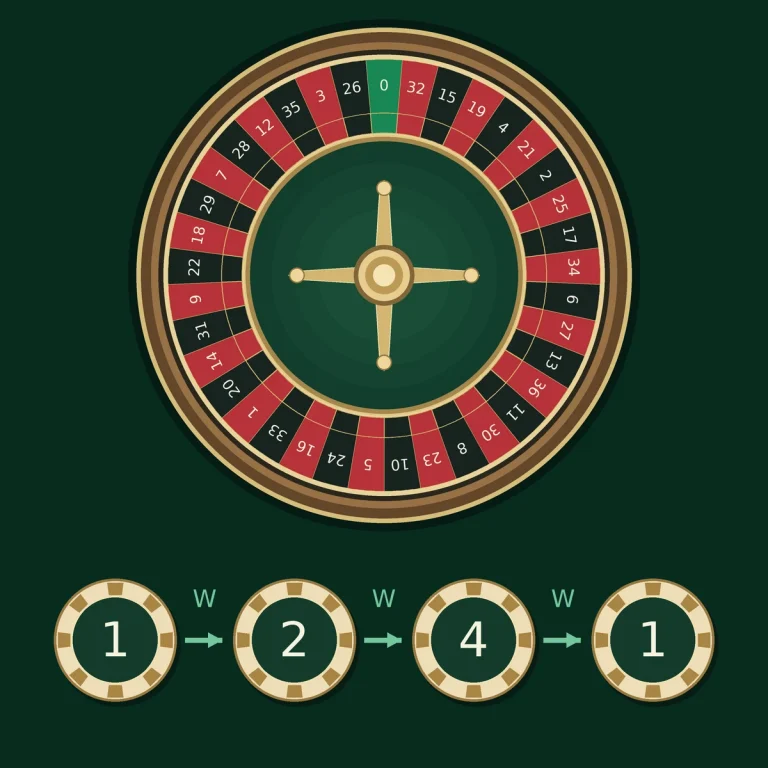
What is the Paroli roulette strategy?
Paroli is a positive progression, commonly described as Reverse Martingale or Anti-Martingale. Start with one base stake on an even-money roulette bet, double after each full win, and reset to the base stake after a loss or after completing a chosen win-streak target.
The system increases exposure only after winning results, so it avoids Martingale's loss-side doubling pattern. It still does not change the probability of the next spin or the house edge on each unit wagered. The roulette strategy and bankroll-risk guide compares positive, negative and flat-betting systems on the same probability baseline.
Does the Paroli betting system work?
It works as a defined win-streak progression: a completed target cycle can bank several base units while an ordinary pre-target loss costs one base unit under exact 2× even-money rules. It does not create positive expected value. Target cycles become less likely as the required winning streak grows, and the table maximum can block a later doubled wager.
Calculate a Paroli roulette path
Choose the wheel rule, base stake, consecutive-win target, bankroll, table limit and chronological outcome path. Use W for a win, L for a full loss and H only for French la partage.
The path WWLWWWLWW uses stakes of 10, 20, 40, 10, 20, 40, 10, 10 and 20. It completes one target cycle, finishes with two active wins and produces +80.00 units after 180.00 units of action.
| Spin | Outcome | Cycle | Wins before | Stake | Spin result | Cumulative net | Bankroll after | Cycle state after |
|---|---|---|---|---|---|---|---|---|
| 1 | Win | 1 | 0 | 10.00 | +10.00 | +10.00 | 510.00 | 1 / 3 wins · next 20.00 |
How to use the Paroli betting system in roulette
Start with one base stake on an even-money position. After a win, leave the return in play by doubling the next wager. After a loss, return to the base stake and begin a new cycle.
A win-streak target prevents unlimited positive progression. With a three-win target, the bets are one, two and four units. A third consecutive win completes the cycle and the following wager returns to one unit.
The system is also called Reverse Martingale or Anti-Martingale because it increases exposure after wins rather than after losses. Some descriptions end the session at the first loss or target; this calculator starts a new base-stake cycle so one entered path can compare repeated cycles.
Standard cycle formulas
Each winning stake becomes twice as large as the previous one. The target action and profit therefore follow a finite geometric sum.
Stake after k consecutive wins = base stake × 2^k Target-cycle action = base stake × (2^n − 1) Target-cycle profit = base stake × (2^n − 1) Target completion probability = win probability^n Full loss before target = −1 base stake for the cycleThe one-unit failed-cycle result depends on exact 2× progression and even-money payout. A custom multiplier or non-even-money bet would produce different cycle accounting.
Why a failed cycle loses one base unit
Within one cycle, suppose a loss arrives after k consecutive wins but before the target. The completed wins earned 1 + 2 + … + 2^(k−1) = 2^k − 1 base units. The losing stake is 2^k units.
Subtracting that stake leaves a cycle result of −1 unit. A loss on the first wager loses one base unit; a loss after two wins also loses one base unit because the prior profits funded most of the four-unit wager.
This caps each ordinary failed cycle at one base-unit loss, but it does not make the sequence profitable. Successful cycles occur with probability p^n, while failed cycles are much more common as the target length increases.
Cycle loss and loss from the peak are different. With a $10 base, two wins leave the cycle at +$30. The next $40 loss changes that to −$10: a $40 fall from the peak. Those earlier winnings are already part of the bankroll, even though only $10 was committed at the start.
Paroli roulette strategy example: three-win cycle
With a ten-unit base and a three-win target, a successful cycle places 10, 20 and 40. All three wins return 70 units of net profit, then the next cycle begins at 10.
| Cycle outcome | Stakes placed | Cycle result | European probability | Next wager |
|---|---|---|---|---|
| L | 10 | −10 | 19/37 | Reset to 10 |
| WL | 10, 20 | −10 | (18/37)(19/37) | Reset to 10 |
| WWL | 10, 20, 40 | −10 | (18/37)²(19/37) | Reset to 10 |
| WWW | 10, 20, 40 | +70 | (18/37)³ | Target reset to 10 |
Bankroll behavior
The bankroll has a useful internal property within a winning cycle. If the opening base stake is affordable, each later doubled wager in a winning cycle is also bankroll-funded by the accumulated wins.
After k wins, the bankroll has gained base × (2^k − 1), while the next stake is base × 2^k. The difference is the starting bankroll minus one base stake. That is why the bankroll check normally fails only at a new base wager after enough unsuccessful cycles.
The failed-cycle capacity card is a stress test that assumes repeated cycles each end in a full loss before the target. Successful cycles increase the bankroll and extend that capacity. It is a bankroll-only count; table limits can stop a cycle before that full loss occurs, and half-loss cycles have different results.
Table-limit pressure
The table maximum is the main hard constraint inside a winning run. A ten-unit base requires wagers of 10, 20, 40, 80, 160 and 320; the next doubled stake would be 640.
The calculator reports how many consecutive winning wagers fit at or below the selected limit. A target is feasible only when its final required bet is allowed.
A table that supports six consecutive wins does not make a six-win streak likely. It only means the bet sizes can be placed if those wins occur.
For context on available game formats and table rules, see https://roulettecalc.com/casinos/. Enter the actual maximum for the even-money position you are comparing.
French la partage and H handling
Under French la partage, zero returns half of an eligible even-money stake and loses the other half. The calculator represents that result with H and gives it probability 1/37.
Because the Paroli progression advances only after a full win, this implementation treats H as a cycle-ending non-win: half the current wager is lost and the next stake resets to base. That convention is explicit because historical descriptions do not provide one universal progression rule for a half-loss.
En prison is excluded because the stake remains unresolved into a later spin and therefore needs a separate multi-spin settlement model.
Does Paroli roulette beat the house edge?
No. European even-money wagers retain a 1/37 expected loss per unit, American wagers retain 2/38 and eligible French la partage wagers reduce the cost to 0.5/37. Doubling only after wins changes the correlation between gains and total wagered.
The edge-cost card applies the selected house edge to the realised path action. It is a turnover-based benchmark, not a forecast conditional on the outcome sequence you entered. The path result itself is calculated from its actual W/L/H settlements.
Paroli and Martingale have related formulas, but they do not have the same outcome distribution. For example, in a fair 50/50 game with a one-unit base and three-bet cap, Paroli pays +7 with probability 1/8 and −1 with probability 7/8. Martingale pays +1 with probability 7/8 and −7 with probability 1/8. Their mean and variance match in this example, while their upside and downside are reversed. The roulette RTP and expected-loss calculator separates stake volume from return percentage.
Paroli vs Martingale: why it is called Reverse Martingale
Paroli and Martingale use opposite progression directions. Paroli doubles after wins and resets after a loss; Martingale doubles after losses and resets after a recovery win. The Martingale roulette calculator shows how that reversal changes bankroll and table-limit pressure without changing the underlying wheel probabilities.
| System | After a win | After a loss | Typical cycle target | Main risk |
|---|---|---|---|---|
| Paroli / Reverse Martingale | Double | Reset to base | Chosen consecutive-win count | Giving back a developing winning cycle |
| Martingale | Reset to base | Double | One recovery win | Exponential stakes during losing streaks |
| Flat betting | Keep stake | Keep stake | None | Total action over time |
This page is educational and does not identify future winning streaks. Set a base stake, loss limit and time limit before play. Do not increase the target because a sequence is close to completion.
Fixed-stake comparison
The flat result shown beside the calculator keeps the base stake unchanged over only the outcomes that Paroli processed. It is a theoretical comparison: it does not run its own bankroll or stopping checks, and neither result includes unprocessed outcomes after Paroli stops.
Same win count, different order
Both examples assume a bankroll and table limit of 500 units. On the same wheel, these two exact ordered sequences have equal probability p³q². Their different results illustrate stake timing, not a way to predict a better sequence.
For a baseline without Paroli's changing win-streak exposure, use the roulette session simulator. It keeps the wager fixed, so it is useful for comparing ordinary session variance with the positive progression modeled here; it is not a Paroli simulator.
Common questions about the Paroli system
What is the Paroli betting rule?
Begin with one base stake, double after each win and reset after a loss or after completing the chosen consecutive-win target.
Is Paroli the same as Reverse Martingale?
Yes, Paroli is commonly described as Reverse Martingale or Anti-Martingale because the progression increases after wins instead of after losses.
Does the Paroli roulette strategy work?
It can complete profitable win-streak cycles, but it does not change roulette expected value. Losing cycles are more common than a multi-win target cycle, and the table maximum can stop a later doubled stake.
Why do many versions stop after three wins?
Three wins produce a short 1-2-4 cycle and seven base units of profit. Longer targets create larger final stakes and sharply lower completion probability.
How much does an unsuccessful cycle lose?
With exact doubling and even-money payouts, any full loss before the target leaves the cycle one base unit down.
Can the bankroll block a doubled stake after wins?
If the base stake was affordable and no table limit intervenes, the previous wins fund each next doubled bet. Repeated failed cycles can later make even the base stake unaffordable.
Does Paroli roulette predict a hot streak?
No. The system reacts after wins; it does not change or forecast the probability of the next spin.
Does the system change roulette RTP?
No. It changes stake timing and session volatility, while the wheel and zero rule determine expected return per unit.
Sources and calculation basis
- Wizard of Odds — Anti-Martingale rules: even-money use, one-unit start, doubling after wins and ending after a loss or target.
- Peter Pflaumer, “Analyzing Paroli and Let-It-Ride Betting Systems: Expected Gain, Variance, and Risk Measures in Roulette,” 19th International Conference on Gambling & Risk Taking, Bellagio, May 26–28, 2026 — conference abstract on expected gain, variance and unchanged house edge.
- Merriam-Webster — historical definition of paroli as carrying the stake and winnings into a further wager.
Was this tool helpful?
What went wrong?
For calculation problems, inputs and results are attached to your report.