Triple Zero Roulette Odds, RTP and Payouts
This triple-green roulette format uses 39 pockets: numbers 1–36 plus three green outcomes. One approved version labels them 0, 00 and 000; another uses a casino logo as the third green pocket. The extra outcome lowers standard-bet RTP to 92.31% and raises the house edge to 7.69%.
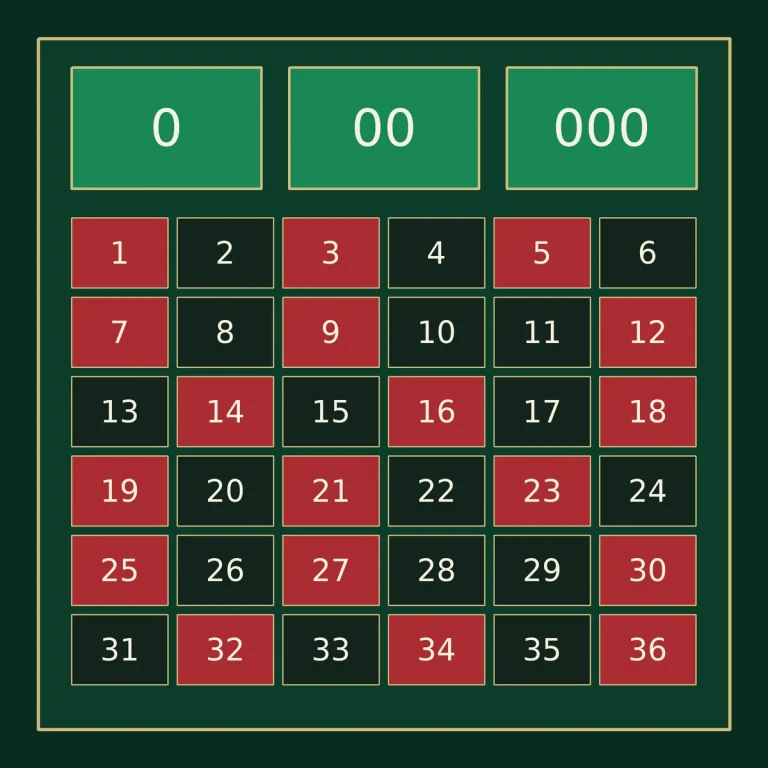
What is triple zero roulette?
Triple zero roulette is a 39-pocket roulette format with numbers 1–36 plus three green outcomes. In the Huxley approved game those green pockets are 0, 00 and 000; Venetian Roulette uses 0, 00 and a branded Venetian logo as the 39th pocket. The roulette wheel layout guide explains the standard 37- and 38-pocket structures that this extra green outcome extends.
Most ordinary payouts remain the familiar roulette payouts. For a standard bet, coverage multiplied by the gross payout multiple equals 36: for example, a split covers two pockets and returns 18 times its stake on either one. That produces 92.31% theoretical RTP and a 7.69% house edge. Use the RTP and house-edge calculator to compare that long-run cost with European, American and French roulette models.
Why does triple zero roulette have worse odds?
The third green outcome creates one more losing result without increasing the usual payout on standard bets. American double-zero roulette has a 5.26% standard edge; adding a third green outcome raises the standard triple-zero edge to 7.69%. The roulette probability calculator handles repeated-spin probabilities, while this page keeps the 39-pocket variant and its special approved bets separate.
Triple zero roulette calculator
Select an approved 39-pocket model and bet type. The calculator derives hit probability, RTP, house edge, expected return and expected loss from exact coverage and payout rather than using a single hard-coded percentage.
A straight covers one pocket and returns 36 gross units on a win. Across 39 equally likely pockets, its theoretical RTP is 36/39.
Original 2G'$ consecutive-greens calculator
Nevada approved 2G'$ for Triple-Zero Roulette as a standalone side bet. It wins only when a green pocket appears and the immediately following spin is also green. Select one of its eight approved player paytables to calculate RTP and expected loss.
At 155:1 net, the gross return is 156 units. Multiplying 156 by the win probability 1/169 produces 92.31% RTP, equal to the standard 39-pocket bet RTP.
What counts as triple zero roulette?
The Huxley approved rules use a wheel with 39 pockets: 1–36, single zero, double zero and triple zero 000. All three green pockets are explicitly named and colored green.
Venetian Roulette also uses 39 pockets, but the extra green outcome is a Venetian logo rather than a printed 000. Mathematically it is still a third losing green outcome for standard outside bets, yet its special layout and bet names are different.
This page therefore treats “triple zero” as a mathematical category while keeping the approved rule sets separate. The roulette rules guide explains why pocket count, special zero-area wagers and settlement must be checked against the exact table model rather than inferred from a generic game name.
Why standard RTP is 92.31%
Standard payouts are built around 36 gross return units. A straight pays 35:1 plus the returned stake, a split returns 18x gross, a street 12x and an even-money winner 2x.
Across 39 possible outcomes, those payouts produce 36/39 expected gross return, or 92.3077% RTP. The missing 3/39 is the 7.6923% house edge.
Standard RTP = 36 / 39 = 92.3077% House edge = 3 / 39 = 7.6923% Expected loss = total amount wagered × 3/39Triple zero roulette payouts
The Huxley approval lists the usual roulette paytable plus a green-color wager on all three green pockets. Venetian Roulette adds special logo combinations and a five-number top line. For stake-specific gross return, net profit and target-stake calculations on the standard payout ratios, use the roulette payout calculator.
| Bet | Coverage | Net payout | RTP on 39 pockets | Rule note |
|---|---|---|---|---|
| Straight | 1 pocket | 35:1 | 92.31% | Includes 0, 00, 000 or logo when offered as a straight. |
| Split | 2 pockets | 17:1 | 92.31% | Boxes must be adjacent on the approved layout. |
| Street / three-number | 3 pockets | 11:1 | 92.31% | Standard row or approved green combination. |
| Corner | 4 pockets | 8:1 | 92.31% | Four boxes sharing one corner. |
| Venetian top line | 0, 00, 1, 2, 3 | 6:1 | 89.74% | Does not include the Venetian logo pocket. |
| Six line | 6 pockets | 5:1 | 92.31% | Two adjacent rows. |
| Dozen / column | 12 pockets | 2:1 | 92.31% | All three green pockets are excluded. |
| Even-money | 18 pockets | 1:1 | 92.31% | 0, 00 and the third green outcome all lose. |
| Green / Green Outside | 3 green pockets | 11:1 | 92.31% | Huxley: 0, 00, 000. Venetian: 0, 00, logo. |
| Venetian Courtesy Line | 0 and 00 | 17:1 | 92.31% | The logo pocket is excluded. |
Huxley 000 layout
The approved Huxley game explicitly names the third green pocket 000. It lists straight, split, three-number, corner, six-number, dozen, column and even-money wagers at their traditional payouts.
It also defines Color (Green) as a wager on 0, 00 or 000 and pays 11:1. Three covered pockets multiplied by 12 gross units produce the same 36/39 return as other standard bets.
The one-page approved rules confirm the 39-pocket structure and payouts but do not publish a circular wheel sequence, so this calculator does not invent or display one.
Venetian logo layout
Venetian Roulette replaces a printed 000 with a branded 39th pocket. The logo can be played straight at 35:1, split with 0 or 00 at 17:1, or in a three-green street with both zero pockets at 11:1.
Green Outside covers 0, 00 and the logo for 11:1. Courtesy Line covers only 0 and 00 for 17:1. These bets preserve the standard 7.69% edge.
The top line covers 0, 00, 1, 2 and 3 at 6:1. Because it returns only 35 gross units across 39 pockets, its edge is higher at 10.26%.
Triple zero vs double zero vs single zero roulette
| Wheel | Pockets | Green outcomes | Standard RTP | House edge | Expected loss per 100 |
|---|---|---|---|---|---|
| European | 37 | 0 | 97.30% | 2.70% | 2.70 units |
| American | 38 | 0, 00 | 94.74% | 5.26% | 5.26 units |
| Triple zero standard | 39 | 0, 00, 000/logo | 92.31% | 3/39 · 7.69% | 7.6923 units |
| Venetian top line | 39 | Five-number special bet | 89.74% | 10.26% | 10.26 units |
Moving from European to triple zero almost triples the expected cost of the same standard payout structure: 7.69 units instead of 2.70 per 100 wagered.
The same 1,000 units of action
One hundred wagers of 10 units and two hundred wagers of 5 units both create 1,000 units of action. Their expected cost is equal at the same edge, but their possible session results differ. Turnover can include money returned and wagered again; it is not a required starting bankroll.
When comparing casino roulette tables by pocket count and payout rules, identify the actual wheel and posted paytable. A roulette label alone does not distinguish 37, 38 and 39 pockets.
How the two-green side bet works
The original approved 2G'$ wager begins before a spin. If the first result is not green, the wager loses. If the first result is 0, 00 or 000, the bet remains active for exactly one more spin.
It wins only if the next result is also green. With three green pockets out of 39 on each independent spin, the win probability is (3/39)² = 1/169, or about 0.59%.
Its approved rules list eight player paytables from 130:1 through 165:1. These belong to the original standalone game and should not be confused with the separate Dealer Envy approval.
Count fresh attempts, not overlapping pairs
An attempt uses one spin with probability 12/13 and two spins with probability 1/13: on average, 14/13 spins. Therefore 100 fresh attempts use about 107.69 spins on average, not exactly 100 or 200.
In a sequence green–green–green, a wager before the first spin wins after the second. A fresh wager may start before the third; the second and third results do not create another win for the original stake. If the first spin of an active wager has already been green, its conditional chance of winning on the next spin is 1/13. The displayed 1/169 is the chance before a fresh attempt begins.
Why the side-bet edge varies
The probability stays fixed at 1/169, but gross return changes from 131x to 166x. At 155:1 net, 156/169 simplifies exactly to 12/13, which is also 36/39. This paytable therefore has exactly the same RTP as a standard bet on the 39-pocket wheel.
Every original paytable below 155:1 is worse than the main game, while 160:1 and 165:1 are better in theoretical return. The highest original paytable is 165:1, producing 98.22% RTP and a 1.78% edge.
A side-bet name does not determine its value. The exact posted paytable changes expected loss by more than twenty percentage points across the approved range.
Approved 2G'$ paytable comparison
| Net payout | Gross multiple | RTP | House edge | Cost per 100 wagered |
|---|---|---|---|---|
| 130:1 | 131x | 77.51% | 22.49% | 22.49 units |
| 135:1 | 136x | 80.47% | 19.53% | 19.53 units |
| 140:1 | 141x | 83.43% | 16.57% | 16.57 units |
| 145:1 | 146x | 86.39% | 13.61% | 13.61 units |
| 150:1 | 151x | 89.35% | 10.65% | 10.65 units |
| 155:1 | 156x | 92.31% | 3/39 | 7.6923 units |
| 160:1 | 161x | 95.27% | 4.73% | 4.73 units |
| 165:1 | 166x | 98.22% | 1.78% | 1.78 units |
Original 2G'$ versus Dealer Envy Bets
The calculator above models the original 2G'$ for Triple-Zero Roulette approval. Its two-page rules contain eight player paytables: 130:1, 135:1, 140:1, 145:1, 150:1, 155:1, 160:1 and 165:1.
Dealer Envy Bets for 2G'$ is a separate Nevada-approved game. It can add a dealer payment calculated from an Envy multiplier applied to the player’s original wager, so its paytable identifiers describe both the player award and the dealer feature.
For triple zero roulette analysis, the two approvals must remain separate. The Dealer Envy version has a different paytable structure, so it is not included in this calculator and must be evaluated from its posted player payout and Envy setting.
Does a third zero change betting strategy?
Triple zero roulette changes the probability and expected cost, not the independence of the next spin. A fixed straight still covers one pocket, an even-money wager still covers eighteen numbers, and previous outcomes do not remove any of the three green pockets.
Progression systems increase or decrease stake exposure but cannot change 36/39 standard RTP. Covering all three greens at 11:1 also retains the same 7.69% edge; it merely changes hit frequency and payout size.
The practical mathematical choice is between rule sets and paytables, not between number patterns.
Related roulette variants and bet mechanics
Use these pages when the question moves from triple-zero mathematics to the standard double-zero model or to chip-placement rules for individual bets.
Common questions about triple zero roulette
How many pockets are on a triple-zero wheel?
A standard triple-green model has 39 pockets: numbers 1–36 plus 0, 00 and either 000 or another approved third-green symbol.
Why is triple zero roulette considered worse for the player?
For standard payouts, the third green outcome raises the house edge to 7.69%. That is higher than the 5.26% standard edge on double-zero American roulette and the 2.70% standard edge on single-zero European roulette.
What is the house edge on a 39-pocket wheel?
Correctly paid standard bets have a 7.69% house edge because they return 36 gross units across 39 possible outcomes. Special bets can have a different edge.
What is the RTP of triple zero roulette?
Standard bets have 92.31% RTP. The Venetian five-number top line has 89.74%, while the approved two-green side bet ranges from 77.51% to 98.22% depending on paytable.
Does every triple-zero wheel use 000?
No. Huxley’s approved version uses 000, while Venetian Roulette uses a branded logo as the 39th pocket.
Does the third green pocket pay 35:1 on a straight?
Both cited approved variants allow a straight wager on the third green outcome at 35:1. That payout still produces the standard 7.69% edge across 39 outcomes.
Is the original 2G'$ side bet good at 165:1?
The highest original paytable has 98.22% theoretical RTP under the documented 0/00/000 model. A separate Dealer Envy version also exists, so the posted game name and player paytable must be checked before applying this figure.
Primary approved-game sources
- Nevada Gaming Control Board — approved game rules index.
- Huxley Triple-Zero (“000”) Roulette — 39-pocket structure, standard payouts and three-green wager.
- Venetian Roulette — logo pocket, top line, Green Outside and Courtesy Line rules.
- 2G'$ for Triple-Zero Roulette — consecutive-green procedure and approved 130:1–165:1 paytables.
- Dealer Envy Bets for 2G'$ — separate optional dealer-payout feature and Envy multiplier structure.
Was this tool helpful?
What went wrong?
For calculation problems, inputs and results are attached to your report.
Was this tool helpful?
What went wrong?
For calculation problems, inputs and results are attached to your report.