Martingale Roulette Calculator and Bankroll Risk
Use the calculator to measure how quickly a doubling progression grows, how much bankroll it requires and where the table maximum stops the sequence. It also calculates exact cycle-failure probability and expected result for standard European and American even-money bets.
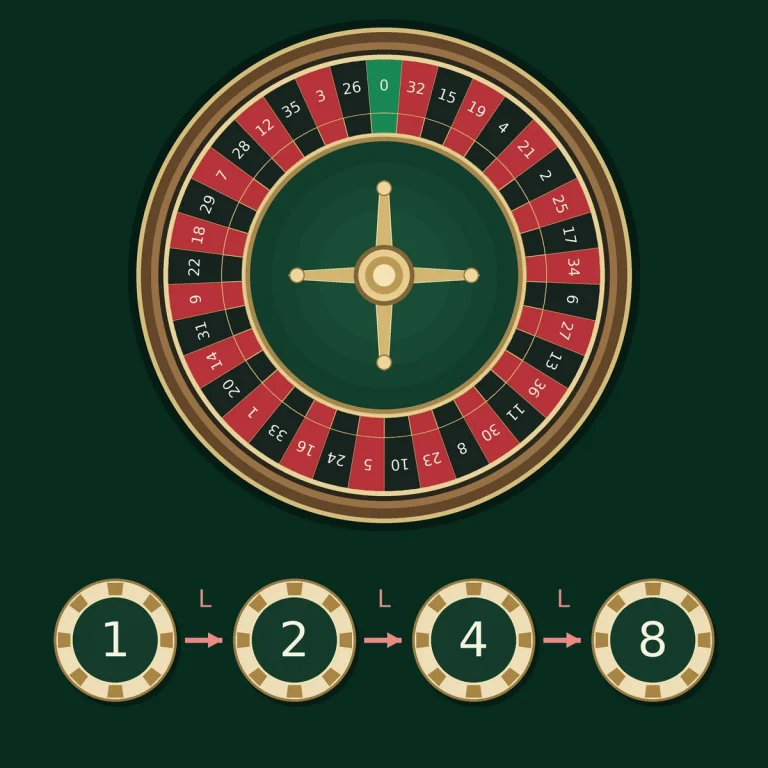
Does the Martingale system work in roulette?
Martingale works as a recovery progression only in the narrow sense that a full 1:1 win after exact doubling recovers the earlier losses in that cycle and leaves one base stake of profit. It does not improve the probability of the next spin or turn roulette into a positive-expectation game.
The practical failure point is finite capital. Stakes grow exponentially, while roulette keeps the same house edge on every accepted wager. A sufficiently long losing run eventually reaches the bankroll limit, the table maximum or both. The roulette strategy guide compares Martingale with other staking systems without treating any progression as a way to change the wheel probabilities.
Why does the Martingale strategy fail?
Martingale roulette calculator
Enter a base stake, available bankroll, table maximum and number of losses to inspect. The capacity model stops when either the next doubled bet exceeds the table limit or cumulative losses plus that bet exceed the bankroll.
With a 10.00-unit base, the bankroll and table limit permit six bets: 10, 20, 40, 80, 160 and 320. Six consecutive European losses cost 630.00 units and block the required 640.00-unit next bet.
| Bet | Losses before bet | Stake | Cumulative loss before bet | Total lost if this bet loses | Probability of reaching bet | Net if this bet wins | Status |
|---|
How the Martingale system works
The classic roulette Martingale is applied to red/black, odd/even or 1–18/19–36. Start with base stake B. After every full loss, double the next stake. After a 1:1 win, return to B and begin a new cycle.
If a win occurs after n losses, the winning stake is B × 2n. Earlier losses total B × (2n − 1), so the cycle closes with B units of profit. The tool applies the identity at every displayed progression level.
Next stake after n losses = B × 2ⁿ Cumulative loss after n losses = B × (2ⁿ − 1) Bankroll required through the next bet = B × (2ⁿ⁺¹ − 1)Why table limits matter
Recovery requires the next doubled bet to be accepted. A player can still have money remaining and fail because the next wager exceeds the table maximum. The opposite can also happen: the table permits the stake, but the remaining bankroll does not.
The calculator tests both conditions at every level. The final permitted bet is the largest progression step that fits the position limit and can be funded after all earlier bets have lost.
Changing from a physical table to an online interface does not remove this boundary. Every game has accepted stake limits, even when they are presented through a digital control.
For context on table rules and available game formats, see https://roulettecalc.com/casinos/. Use the actual even-money minimum and maximum from the selected table when entering these figures.
Martingale strategy chart and progression example
With a one-unit base, each additional loss doubles the next wager and roughly doubles the capital needed to continue.
| Consecutive losses | Next stake | Cumulative loss | Capital required through next bet |
|---|---|---|---|
| 0 | 1 | 0 | 1 |
| 1 | 2 | 1 | 3 |
| 2 | 4 | 3 | 7 |
| 3 | 8 | 7 | 15 |
| 4 | 16 | 15 | 31 |
| 5 | 32 | 31 | 63 |
| 6 | 64 | 63 | 127 |
| 7 | 128 | 127 | 255 |
| 8 | 256 | 255 | 511 |
| 9 | 512 | 511 | 1,023 |
| 10 | 1,024 | 1,023 | 2,047 |
What happens with a $20 bankroll?
At a $1 base, a win on the fourth bet pays $8 profit plus the $8 winning stake back. Subtract the earlier $7 of losses: the cycle profit is $1. The same sequence on a table capped at $5 stops before the $8 bet, after losing $7.
Grand Martingale: what does adding a base unit change?
For this comparison, Grand Martingale means doubling the previous stake and adding one base unit after each loss, then resetting after a win. With B = 1, that gives 1, 3, 7, 15. The calculator above uses classic doubling only.
| Losses before a win | Classic next stake | Grand next stake | Grand earlier losses | Grand cycle profit after a 1:1 win |
|---|---|---|---|---|
| 0 | 1 | 1 | 0 | +1 |
| 1 | 2 | 3 | 1 | +2 |
| 2 | 4 | 7 | 4 | +3 |
| 3 | 8 | 15 | 11 | +4 |
The extra profit on a successful cycle comes from larger stakes. Four full losses cost 26 base units instead of 15. At the same $20 bankroll and $1 base, the Grand sequence stops after losing $11 because the next $15 bet cannot be funded. The classic sequence allows four bets; this variant allows three. Neither changes the probability of the next spin.
Compare both progressions with your limits
Both columns use the inputs above: the same base stake, bankroll, table maximum, wheel and selected loss count. They stop at the first wager that cannot be placed. The fixed-cycle count above applies only to the classic calculator.
Standard 1:1 bets only: zero is a full loss (and 00 is also a full loss on the American wheel). This comparison does not model la partage, surrender or en prison. Use a base stake accepted by the table; no chip rounding is applied.
Enable JavaScript to compare your settings. The one-unit examples above remain available.
Cycle failure means all permitted bets lose and the next required stake is blocked; it does not necessarily mean an empty bankroll. Its probability is qm, where m is that column’s permitted bet count. The expected result includes every possible first win and the all-loss stop. A lower failure frequency alone does not mean a better expected result.
For Grand, after n full losses the theoretical stake is B × (2n+1 − 1), earlier losses total B × (2n+1 − 2 − n), and a permitted 1:1 win leaves (n + 1) × B cycle profit. These identities describe the defined progression, not a promise that the next bet can be funded.
European versus American loss streaks
An even-money European wager wins on 18 pockets and loses on 19, including zero. Its one-spin loss probability is 19/37, or 51.35%. On an American wheel it wins on 18 and loses on 20, giving 20/38, or 52.63%.
The difference compounds through a sequence. Six consecutive losses have probability (19/37)6 = 1.83% on European roulette and (20/38)6 = 2.13% on American roulette.
A small per-spin difference therefore increases both the chance of reaching the largest bets and the expected cost of the cycle.
Why a high cycle win rate is misleading
A six-bet European cycle succeeds about 98.17% of the time. That sounds favorable, but each success earns only one base stake, while the failed cycle loses 63 base stakes.
The asymmetric outcomes are the whole system: frequent small profits are exchanged for a less frequent loss large enough to erase many completed cycles. A success percentage alone does not describe expected value.
With m permitted bets, one failed cycle requires 2m − 1 successful cycles merely to recover its progression loss.
If increasing stakes after losses is turning into attempts to recover money already lost, stop the progression rather than extending it. The responsible gambling guide covers limits, breaks and support options.
Expected value in the Martingale roulette calculator
Let q be the probability that the even-money wager loses and m the number of permitted bets. The cycle fails only if all m bets lose, so its failure probability is qm.
Every successful cycle earns B. A failure loses B × (2m − 1). Combining those outcomes gives a negative expectation whenever q exceeds one half, as it does on both standard roulette wheels. The roulette RTP and expected-loss calculator provides the underlying wheel-level house-edge baseline independently of the staking progression.
Cycle failure probability = qᵐ Expected cycle result = B × [1 − (2q)ᵐ] Expected cycle action = B × [(2q)ᵐ − 1] / (2q − 1)Martingale does not change the house edge
Each accepted even-money stake still has the normal expected loss for its wheel: 1/37 on European roulette or 2/38 on American roulette. The progression only changes how much action occurs at each level.
The expected cycle loss equals expected cycle action multiplied by the same house edge. Doubling cannot turn a negative expected wager into a positive expected sequence.
This also explains why extending the progression with a larger bankroll does not solve the problem. It reduces failure frequency while increasing the size of the eventual failure.
Fixed cycles versus a real bankroll path
The multi-cycle result treats every cycle as an independent copy with the same maximum depth. It answers: what happens if this exact risk unit is repeated C times?
A real bankroll changes after every cycle. Successful cycles add one base unit, while a failure removes the full progression loss and may prevent further play. Because that path is state-dependent, it should not be confused with the fixed-depth comparison.
A failed cycle is not automatically bankruptcy: unused funds can remain below the next required stake. The repeat-cycle comparison assumes each cycle has enough starting funds and the same depth; it is not the probability of exhausting one shared bankroll.
The displayed probability of at least one failure is exact for the stated independent-cycle model: 1 − (1 − qm)C. This is the repeat-cycle result shown by the tool.
For a fixed-stake baseline without Martingale’s changing wager sizes, use the roulette session simulator. It is useful for comparing ordinary session variance with the progression model here, but it does not simulate Martingale stake escalation.
Which roulette bets fit classic Martingale?
The recovery proof assumes a full 1:1 win and a full one-unit loss. It fits red/black, odd/even and low/high under standard zero treatment.
Dozens, columns and inside bets have different payout ratios, so blindly doubling them does not represent the classic formula. La partage, surrender and en prison also change what happens on zero; a half loss or held stake requires a different state model.
For that reason this calculator deliberately excludes special-zero variants rather than pretending they follow the same two-outcome progression.
Past losses do not make the next even-money outcome more likely to win. The next spin still uses the same wheel probabilities, while the Martingale stake becomes larger.
Related roulette progression comparisons
Compare how these systems change the next stake after a win or loss. A gentler increase can delay the table limit, but it does not guarantee recovery or remove the house edge.
Common questions about the Martingale system
How much bankroll does Martingale require?
To survive n losses and place the next doubled wager, the required capital is B × (2n+1 − 1), where B is the base stake. Six losses followed by a seventh bet require 127 base units.
Does the Martingale system work in roulette?
It can recover prior losses when a full 1:1 win arrives before the progression is blocked, but it does not improve expected value. A sufficiently long losing run reaches the bankroll or table limit and creates the large loss the system postpones.
What happens after a Martingale win?
Under the classic system the next wager resets to the base stake. If all earlier losses were doubled exactly and the winning bet paid 1:1, the completed cycle profit equals one base stake.
Is Martingale better on European roulette?
European roulette has a lower even-money loss probability and house edge than American roulette. This reduces loss-streak and expected-cost figures, but the progression still has negative expectation.
Why does the Martingale strategy fail?
The required stake grows exponentially while the next-spin probability stays unchanged. Ten losses require a next bet 1,024 times the base and total capital of 2,047 base units through that wager, so real bankroll and table limits eventually stop the recovery sequence.
Is there a 100% profitable Martingale strategy?
No. With finite capital and a table limit, there is always a nonzero probability that all permitted bets lose. In the standard model here, each wager has negative expected value. A high chance of a small cycle profit is not a guarantee of a profitable session.
Does Martingale work with la partage?
The classic two-outcome formula does not directly apply because zero creates a half loss rather than a full loss. A correct la partage progression needs separate treatment of that intermediate bankroll state.
Rule and research sources
- 58 Pa. Code § 617a.1 — 37-pocket single-zero and 38-pocket double-zero wheel structures.
- 58 Pa. Code § 617a.4 — 1:1 even-money payouts and standard loss on 0 or 00.
- UNLV International Gaming Institute — A Statistical Analysis of the Roulette Martingale System: Examples, Formulas and Simulations with R.
Was this tool helpful?
What went wrong?
For calculation problems, inputs and results are attached to your report.