Roulette Payout Calculator
Calculate roulette payouts and winnings as net profit, gross return and the minimum stake needed for a target win. Choose a standard roulette bet, enter any stake and switch between common currencies or neutral betting units.
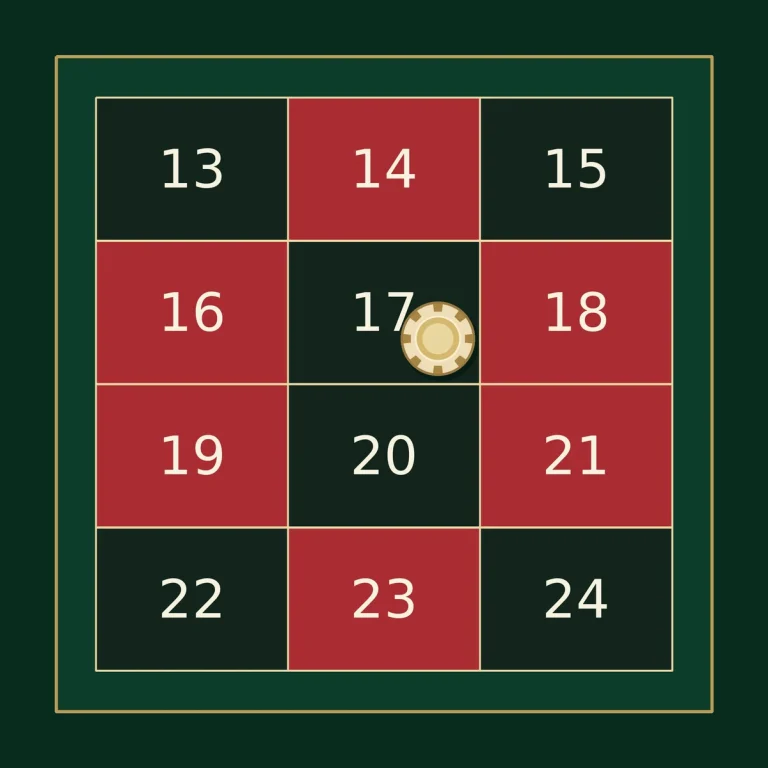
Calculate roulette payouts and winnings by bet and stake
Select a bet, stake, currency and wheel. The calculator shows the winning profit, total amount returned, one-spin hit chance and the minimum stake required for a target net profit.
Current calculation
A $10.00 straight bet pays 35:1. A win produces $350.00 net profit and $360.00 gross return including the original stake.
Standard payout vs fair payout
A fair payout would give a bet zero expected net profit. It would still have winning and losing spins. This is a mathematical benchmark, not a payout offered by the table.
For k winning pockets out of N equally likely pockets, the fair profit ratio is (N − k) / k. Gross return adds the winning stake back. For example, a single number on a 37-pocket wheel would need 36:1 profit instead of the standard 35:1.
Enable JavaScript to compare the selected bet and stake.
| At the selected stake | Standard | Fair · hypothetical |
|---|
Model: a fixed profit on a win or a full stake loss otherwise. Even-money bets lose in full on zero here. La partage, en prison, surrender and multiplier games need their own settlement models. “≈” marks rounded values; amounts smaller than 0.01 are shown explicitly. Fair returns use the exact ratio before rounding the display, without imposing a hypothetical chip denomination.
Compare stakes and winning payouts
A stays fixed. B follows the fields above. Differences are B minus A, rounded to two decimal places. pp means percentage points.
| Measure | A · Saved | B · Current | Difference |
|---|
Winning payouts are conditional on the bet winning. A larger payout or smaller target stake does not make a bet safer. The target-stake calculation is separate from the selected stake above.
Minimum target stakes use increments of 0.01. Actual table minimums and chip denominations may require a larger stake. Different currencies and betting units are not converted.
A is saved for this page visit only. Share result shares the current calculation (B), without the saved comparison.
How are roulette payouts calculated?
Standard roulette payouts are based on the number of covered outcomes out of the 36 numbered spaces. The zero pockets remain possible outcomes, but they are not added when the standard payout ratio is set. For overlapping wagers, use the combined-bet outcome calculator; for Voisins, Tiers, Orphelins and other racetrack packages, use the call-bet package calculator.
For most standard bets, divide 36 by the number of covered numbers and subtract 1. A corner covers four numbers, so 36 ÷ 4 − 1 gives an 8:1 payout.
Standard payout ratio = (36 ÷ numbers covered) − 1 Net profit = stake × payout ratio Gross return = stake + net profit Minimum stake for target = target profit ÷ payout ratio, rounded upIs 35:1 profit or total return?
A quoted 35:1 payout means 35 units of net profit for every 1 unit staked. The winning stake is also returned, so the gross return is 36 units.
For a 10-unit straight bet, the net profit is 350 units and the gross return is 360 units. Treating 35:1 as the total return would understate the amount returned, while counting the stake twice would overstate the profit.
The same distinction applies to every other bet: 17:1 produces an 18x gross return, 2:1 produces 3x gross and 1:1 produces 2x gross.
Net profit here refers to the selected bet. For the whole round, add any profit from other winning bets and subtract every losing stake. Do not add a winning stake twice: it is already included in gross return.
For worked layouts, chip counting and denomination conversions, try the dealer payout practice exercises.
Roulette payout chart: net profit and gross return
The roulette payout chart shows standard net profit and gross return for common bets. Values are expressed in betting units, so the same multiplication works for dollars, euros, pounds or any other currency. Multiplier variants use a different return model; the Lightning Roulette calculator separates boosted straight-number payouts from the base game.
Print a clean reference sheet or keep a copy offline. These exports use the fixed 10- and 25-unit examples below, not the current calculator fields. The HTML file works offline; PDF saving depends on your browser's print options.
| Bet type | Payout | 10-unit net profit | 10-unit gross return | 25-unit net profit | 25-unit gross return |
|---|---|---|---|---|---|
| Straight | 35:1 | 350 | 360 | 875 | 900 |
| Split | 17:1 | 170 | 180 | 425 | 450 |
| Street | 11:1 | 110 | 120 | 275 | 300 |
| Corner | 8:1 | 80 | 90 | 200 | 225 |
| Six line | 5:1 | 50 | 60 | 125 | 150 |
| Dozen | 2:1 | 20 | 30 | 50 | 75 |
| Column | 2:1 | 20 | 30 | 50 | 75 |
| Even-money bets | 1:1 | 10 | 20 | 25 | 50 |
| American first five | 6:1 | 60 | 70 | 150 | 175 |
- Amounts are betting units and apply only when the listed bet wins. Net profit excludes the winning stake; gross return includes it once.
- Straight 0 and straight 00 each pay 35:1. Double zero needs an American wheel. A 0-00 split pays 17:1 only where that placement is offered.
- Even-money bets mean red/black, odd/even and low/high. American first five covers 0, 00, 1, 2 and 3 and pays 6:1.
- Standard payouts shown here do not model la partage, en prison, surrender, multiplier games or special paytables. Check the rules of the specific table.
- For a complete round, add all winning gross returns and subtract all stakes, including losing bets. A payout ratio is not a win probability or a guaranteed return.
How much do you win on roulette?
Roulette winnings depend on the stake and the selected payout ratio. Use the calculator above to separate net profit from the total amount returned. A 20-unit straight bet earns 700 units of net profit and returns 720 units gross. The same 20-unit stake earns 340 units net on a split, 40 units net on a dozen and 20 units net on an even-money bet.
Higher payouts do not make a bet more likely to win. They compensate for covering fewer numbers. Use the probability and streak tool when the main question is probability, repeated-spin risk or the chance of at least one hit. For the long-run cost of the selected wheel and total action, use the RTP and expected-loss calculator.
Stake needed for a target profit
The roulette payout calculator divides the target net profit by the payout ratio. Because practical stakes are normally entered in fixed increments, it rounds the result up to the nearest 0.01 rather than displaying a value that could fall slightly short of the target.
This is only a conditional payout calculation: it shows the stake required if the bet wins. It does not make a high-payout bet safer or more likely to hit. Fixed packages can also cover a pocket without producing the same net return on every outcome; the James Bond outcome calculator shows that distinction for its 14:5:1 allocation.
| Bet type | Payout | Target 50 | Target 100 | Target 500 | Target 1,000 |
|---|---|---|---|---|---|
| Straight | 35:1 | 1.43 | 2.86 | 14.29 | 28.58 |
| Split | 17:1 | 2.95 | 5.89 | 29.42 | 58.83 |
| Street | 11:1 | 4.55 | 9.10 | 45.46 | 90.91 |
| Corner | 8:1 | 6.25 | 12.50 | 62.50 | 125.00 |
| Six line | 5:1 | 10.00 | 20.00 | 100.00 | 200.00 |
| Dozen / Column | 2:1 | 25.00 | 50.00 | 250.00 | 500.00 |
| Even-money bets | 1:1 | 50.00 | 100.00 | 500.00 | 1,000.00 |
| American first five | 6:1 | 8.34 | 16.67 | 83.34 | 166.67 |
Inside bet payouts
Inside bets cover individual numbers or small groups. Straight, split, street, corner and six-line bets therefore produce larger winning returns but miss more often. The roulette bet-placement guide shows the table positions and coverage behind each listed payout.
The largest standard payout is 35:1 on a straight bet. Its gross return is 36 times the stake because the original winning stake is returned with the profit.
Outside bet payouts
Dozens and columns pay 2:1. Red/black, odd/even and high/low pay 1:1. The lower payout reflects their broader number coverage, not a change in how gross return is calculated.
French la partage and en prison can change the treatment of an even-money stake when zero lands, but a normal winning outside bet still uses the standard listed payout. The French roulette calculator models those zero-settlement rules separately.
To compare which formats operators offer, see our roulette casinos by game format. Check the rules of the specific table: a French-language stream alone does not establish that la partage or en prison applies.
Roulette payouts on 0, 00 and green
Zero and double zero are straight-up numbers. A winning bet on either one pays 35:1, exactly like a straight bet on 1 through 36. The green color does not create a separate bonus payout.
On a European or French wheel, 0 has a 1 in 37 hit chance. On an American wheel, 0 and 00 are separate pockets, so either individual straight bet has a 1 in 38 chance. A permitted 0–00 split covers both green pockets and pays 17:1. A triple-zero roulette wheel adds a third green outcome and requires a separate 39-pocket probability and RTP model.
The American first-five or top-line bet covers 0, 00, 1, 2 and 3 and pays 6:1. Use the American double-zero tool for the full double-zero comparison, or the European calculator for single-zero results.
| Green bet | Wheel | Coverage | Payout | 10-unit gross return | 20-unit gross return |
|---|---|---|---|---|---|
| Straight on 0 | European or American | 1 number | 35:1 | 360 | 720 |
| Straight on 00 | American | 1 number | 35:1 | 360 | 720 |
| 0–00 split (where offered) | American | 2 numbers | 17:1 | 180 | 360 |
| First five / top line | American | 5 numbers | 6:1 | 70 | 140 |
50 or 500 on green: one number or both zeros?
Specify the bet, not just the color. A straight bet on 0 or 00 covers one pocket. An American 0–00 split covers both, but pays a lower ratio. The amounts below are conditional on the selected bet winning; the stake is the total amount placed on that bet.
| Total stake | Bet placed | Net profit if it wins | Gross return if it wins |
|---|---|---|---|
| Total stake50 | Bet placedStraight on 0 or 00 | Net profit if it wins1,750 | Gross return if it wins1,800 |
| Total stake50 | Bet placed0–00 split | Net profit if it wins850 | Gross return if it wins900 |
| Total stake500 | Bet placedStraight on 0 or 00 | Net profit if it wins17,500 | Gross return if it wins18,000 |
| Total stake500 | Bet placed0–00 split | Net profit if it wins8,500 | Gross return if it wins9,000 |
These figures use betting units: a 50-dollar stake and a 50-euro stake use the same multiplication. Straight 00 and the 0–00 split require a double-zero wheel; a split must also be offered by the table. If none of the selected pockets wins, the full selected stake is lost.
Is 5 on each zero the same as a 10-unit split?
On a standard American wheel, yes, for the total return and net result, provided the split is offered and both straight bets use equal stakes. With 5 on 0 and 5 on 00, only one straight bet can win on a spin:
- The winning 5-unit straight returns 5 × 36 = 180, including its stake.
- The other 5-unit straight loses. Total stake was 10, so the combined net profit is 180 − 10 = 170.
- A 10-unit 0–00 split also returns 10 × 18 = 180 and nets 170 if either zero wins. Both arrangements lose 10 when a number from 1–36 lands.
Each arrangement covers 2 of 38 pockets, or 5.26%. Unequal stakes on the two zeros produce different returns depending on which zero wins. In the calculator, select 0–00 split and enter the combined stake for the equal-stake comparison.
Roulette payout questions
What is the payout on roulette?
There is no single payout for every bet. Standard profit ratios range from 1:1 on even-money bets to 35:1 on a straight-up number, with split, street, corner, six-line, dozen and column bets between those limits.
Are there any payout tricks for beginners?
A useful arithmetic shortcut is to calculate gross return first: multiply the winning stake by 36 for a straight, 18 for a split, 12 for a street or 9 for a corner. Subtract the original stake for that bet's net profit. For a round with several bets, add the gross returns of all winning bets, then subtract the total stake. For example, a winning 5-unit split returns 5 × 18 = 90 and nets 85. This makes settlement easier to check; it does not improve the chance of winning or remove the house edge.
How does roulette payout work?
The table applies the listed ratio to the chips placed on the winning bet. A 5-unit winning corner at 8:1 produces 40 units of profit, then the original 5-unit stake is added back for a 45-unit gross return.
What does green pay in roulette?
A straight bet on green 0 or 00 pays 35:1. On an American layout, a permitted 0–00 split pays 17:1 and the first-five bet pays 6:1.
Do payouts change between European and American roulette?
Most standard payout ratios are the same. The extra 00 pocket changes the probability and house edge, while the first-five bet exists only on the American double-zero layout.
What roulette bet pays the most?
The standard straight-up bet has the highest regular payout at 35:1. It covers one number and therefore also has the lowest hit chance among standard single bets.