D'Alembert Roulette Calculator
The system increases the wager by one base unit after a full loss and reduces it by one unit after a win, never below the starting unit. This calculator follows an exact outcome path and shows the resulting stakes, action, bankroll pressure and table-limit failure.
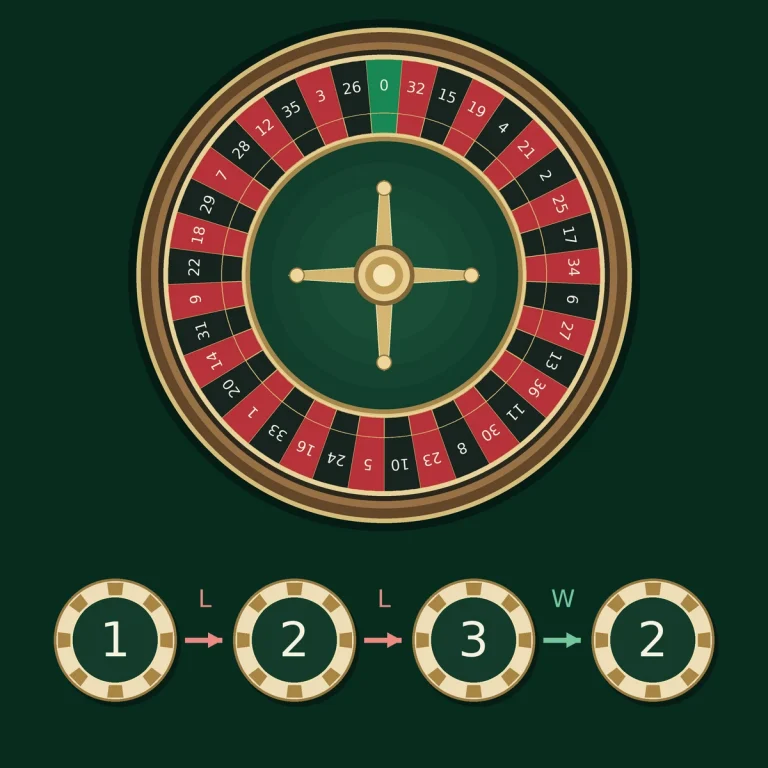
What is the D'Alembert system in roulette?
D'Alembert is a negative progression usually applied to even-money roulette bets. Start with one base unit, add one unit after a full loss and subtract one unit after a win, with a floor of one unit. The stake therefore grows linearly rather than doubling after every loss.
The system can smooth the speed of stake escalation compared with Martingale, but it does not change the wheel probabilities or the house edge. The roulette strategy and bankroll-risk guide places D'Alembert in context with flat betting and other progression systems.
Does the D'Alembert system work?
It works as a defined staking rule: the next bet is easy to calculate and the progression may recover during favorable W/L ordering. It does not create positive expected value, and equal numbers of wins and losses do not guarantee a profit because the outcomes can occur at different stake sizes.
Calculate a D'Alembert roulette path
Enter a wheel model, base unit, bankroll, table limit and chronological outcome path. Use W for a win, L for a full loss and H only for a French la partage half-loss.
The path LLLWLWW starts at 10.00 units and uses stakes of 10, 20, 30, 40, 30, 40 and 30. It finishes 20.00 units ahead after 200.00 units of action. The house-edge figure is a baseline for that realised amount wagered, not an unconditional forecast for every progression session.
| Spin | Outcome | Stake step | Stake | Spin result | Cumulative net | Bankroll after | Next step |
|---|---|---|---|---|---|---|---|
| 1 | Full loss | 1 unit | 10.00 | −10.00 | −10.00 | 490.00 | 2 units |
How the D'Alembert roulette strategy works
The standard sequence begins with one unit. A losing even-money wager raises the next stake to two units, another loss raises it to three, and so on. A win moves the progression down one level, while a win at the one-unit floor leaves the next wager unchanged.
The method is arithmetic: the stake changes by one base unit at a time. It therefore reaches a large table bet more slowly than a doubling system, but a long losing period still produces increasing action and an expanding amount that must be recovered.
The sequence does not wait for wins and losses to “balance.” Every spin remains governed by the selected wheel, and the order of outcomes determines how much money is exposed at each step.
D'Alembert formula and progression math
After consecutive full losses, the stakes form 1, 2, 3, 4 and so on. This makes the all-loss requirement a triangular-number problem rather than the geometric growth used by Martingale.
Next stake after k consecutive losses = base unit × (k + 1) Total action through n consecutive losses = base unit × n(n + 1) / 2 After a win: next step = max(1, current step − 1) Bankroll capacity = floor((√(1 + 8 × bankroll/base) − 1) / 2)These formulas describe an uninterrupted losing run from the one-unit start. A mixed W/L path must be evaluated step by step because each win changes later stakes.
Why outcome order changes the result
The progression is state-dependent. Two paths can contain the same number of wins and losses yet finish with different action, maximum stakes and net results because a win can occur at a large or small progression level.
For example, the default LLLWLWW path uses 20 base units of action and finishes two units ahead. Reordering the same three wins and four losses changes which outcomes receive the larger stakes. The wheel probabilities are unaffected, but the cash path is not.
| Path | Stakes with base 10 | Net result | Total action | Flat result |
|---|---|---|---|---|
| LLWW | 10, 20, 30, 20 | +20 | 80 | 0 |
| WWLL | 10, 10, 10, 20 | −10 | 50 | 0 |
Two wins and two losses, different results. The one-unit floor matters: the opening wins in WWLL cannot reduce the following stake below 10. These examples assume every wager can be funded and is within the table limit; this calculator does not stop automatically when profit first becomes positive.
The flat result is a benchmark using the same base stake on the processed outcomes only. It has no independent bankroll or stopping check, so it is not a separate funded-session simulation.
The table in the calculator preserves chronological order and shows the state after every settled bet. It also stops before an unaffordable or over-limit wager, so it does not count a recovery bet that could not actually be placed.
For a fixed-stake variance baseline without D'Alembert's changing progression state, use the roulette session simulator. It does not simulate D'Alembert stake movement; it provides the comparison case where the wager stays constant.
D'Alembert vs Martingale and Fibonacci
These methods can be applied to even-money wagers, but they create different stake trajectories. None changes the payout, wheel composition or expected value per unit wagered. The Martingale calculator shows exponential doubling after losses, while the Fibonacci roulette calculator follows a recursive sequence rather than a one-unit arithmetic step.
| Method | After a loss | After a win | Growth pattern | Primary constraint |
|---|---|---|---|---|
| D'Alembert | Add one base unit | Subtract one unit, floor at one | Linear | Accumulated action during extended imbalance |
| Martingale | Double the stake | Reset to base | Exponential | Rapid bankroll and table-limit failure |
| Fibonacci | Move forward one sequence position | Move back two positions | Recursive | Large later terms and incomplete recovery paths |
| Flat betting | Keep the same amount | Keep the same amount | Constant | Session length and total action |
Bankroll and table-limit failure
A bankroll still has finite capacity with linear stake growth. A ten-unit base produces stakes of 10, 20, 30, 40 and 50 after repeated losses. Five losses require 150 units in total, and the sixth attempted wager requires another 60.
The calculator checks two independent constraints before every step. The bankroll must cover the next wager after prior results, and the stake itself must remain at or below the table maximum. The first failed check stops the sequence.
The capacity cards model a pure losing run from the initial one-unit position. They are planning limits, not predictions of how many losses will occur.
French la partage and half-loss handling
Under la partage, zero returns half of an eligible even-money stake and loses the other half. The calculator represents that settlement with H and assigns it probability 1/37 on the French model.
This implementation leaves the progression level unchanged after H. For a base of 10, LH uses stakes of 10 and 20, loses 20 in total and leaves the next stake at 20. HL uses 10 and 10, loses 15 and also leaves the next stake at 20. Half-loss order therefore matters too. A half-loss on a 0.01 stake is shown exactly as 0.005; actual chip settlement depends on the table rules.
En prison is not included because the stake remains unresolved and can require later-spin state. That settlement needs a separate multi-spin state model rather than the W/L/H path used here.
Does D'Alembert roulette beat the house edge?
No. European even-money wagers lose 1/37 of total action in expectation, American even-money wagers lose 2/38, and French la partage reduces the expected cost to 0.5/37 on eligible positions. Stake movement changes the distribution of session outcomes, not those per-unit values.
The edge-cost card multiplies the realised path action by the selected house edge. It is useful for comparing how much money the path exposed, but it is not the unconditional expected loss of every possible future path because the progression’s action depends on earlier results.
A sequence can finish ahead, sometimes with a high frequency of modest gains, while rare adverse paths create larger drawdowns. That shape is a risk distribution, not a mathematical advantage. The roulette RTP and expected-loss calculator separates the amount wagered from the wheel's long-run percentage cost.
This page is educational and does not promise winnings. Set a maximum stake, session loss and time limit before play. Do not raise the base unit to recover previous losses, and treat gambling as paid entertainment rather than income.
Where D'Alembert fits among roulette systems
D'Alembert is best treated as one staking path rather than a separate way to alter roulette odds. Choose a base unit and a stopping budget before comparing progressions. Check the actual table minimum, maximum and zero rule as well: these determine which stakes can be placed and how zero settles. Our table-selection comparisons are at https://roulettecalc.com/casinos/.
Common questions about the D'Alembert system
What is the D'Alembert betting rule?
The standard rule starts with one base unit, adds one unit after a full loss and subtracts one unit after a win. The next stake does not fall below one unit.
Is D'Alembert safer than Martingale?
Its linear stake growth is slower than Martingale doubling, so a table limit is normally reached later. It can still create substantial cumulative action and bankroll loss during an extended adverse run.
What is Reverse D'Alembert?
Reverse D'Alembert inverts the usual progression direction: the stake typically increases after a win and decreases after a loss, subject to a minimum stake. It is a different positive-progression variant and is not modeled by this standard D'Alembert path calculator.
Why can equal win and loss counts finish at a loss?
With a base of 10, WWLL stakes 10, 10, 10 and 20 and finishes −10. Reordering those outcomes as LLWW stakes 10, 20, 30 and 20 and finishes +20. The one-unit floor and continued play after a profit make the order relevant in this model.
What does H mean in the calculator?
H is a French la partage half-loss on zero. The page deducts half the current stake and holds the same progression step for the next wager.
Does the system change roulette RTP?
No. It changes total action and the distribution of cash results. The selected wheel and settlement rule determine the house edge on each unit wagered.
Can the exact path probability predict the next spin?
No. It is the probability of the exact processed sequence under the selected model. If a limit stops the calculation, it covers only the processed prefix, not the unused outcomes or every path that could cause a stop. It does not identify the next spin.
Sources and calculation basis
- Wizard of Odds — one-unit movement and risk discussion; its goal-based variant can reduce stakes, unlike this full-stake path model.
- F. Downton, “Rational roulette” — arithmetic D'Alembert definition and comparison with faster progressions.
- Harry Crane and Glenn Shafer, “Risk is random: The magic of the d'Alembert” — historical and mathematical analysis of small-win probability and downside risk.
Was this tool helpful?
What went wrong?
For calculation problems, inputs and results are attached to your report.